7 Best AI Engineering Intelligence Platforms
7 min read• Feb 18, 2026
Written by

Milestone Team

Software teams don’t usually fall short due to a lack of effort or commitment. Work stalls in review, priorities keep shifting, and fast releases turn into long cleanup cycles, creating the struggle. That’s where AI engineering intelligence platforms help. They connect to your source control and look at project management tickets, data from CI/CD pipelines, and incident management systems to find usable insight, bottlenecks, rework, risky areas, review friction, capacity signals, and trends without turning engineering into surveillance.
If you’re evaluating software engineering intelligence platforms, this guide walks through seven strong options and explains how to choose the right one for your engineering team.
An engineering intelligence platform is a system that:
Some tools are more into reporting, providing detailed dashboards with various metrics. Others lean toward decision support for engineering leadership, linking delivery to business outcomes and developer experience.
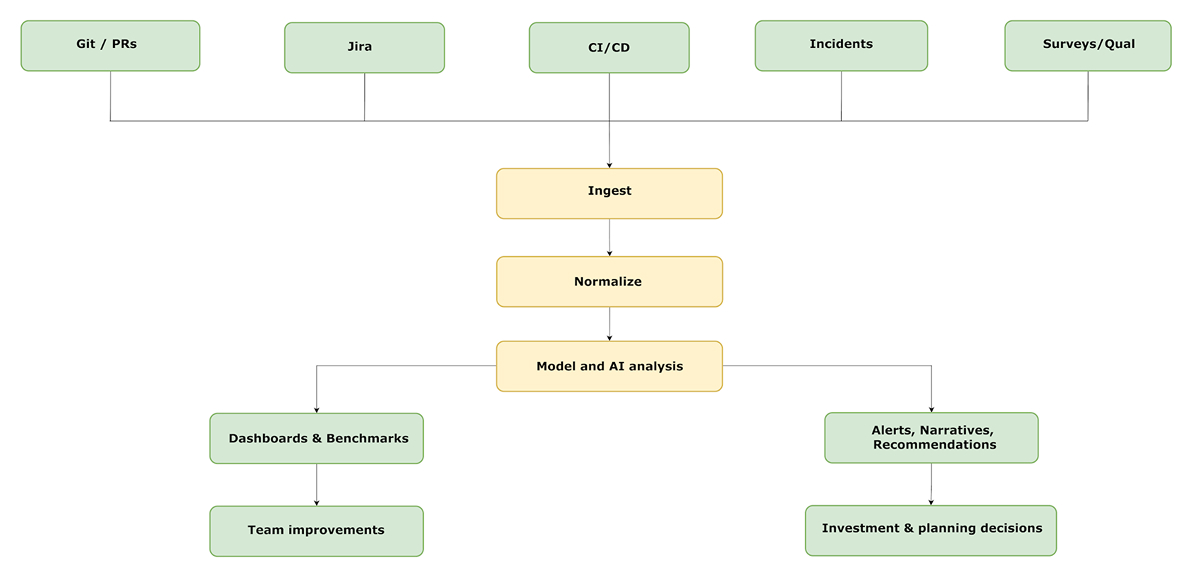
Traditional analytics tools can tell you what happened (e.g., cycle time increased). Engineering intelligence tells you why. For example, it may share detailed insights such as that the review wait time is up because two core reviewers are overloaded, and the PR size has grown. That’s why it matters, because it’s the difference between providing a symptom and identifying the root cause of a problem.
Here are the practical differences you’ll notice:
If you’ve ever had a dashboard that triggered arguments instead of improvements, you already understand the value here.
We evaluated tools using criteria that matter across several organizations. The selection criteria include evaluating:
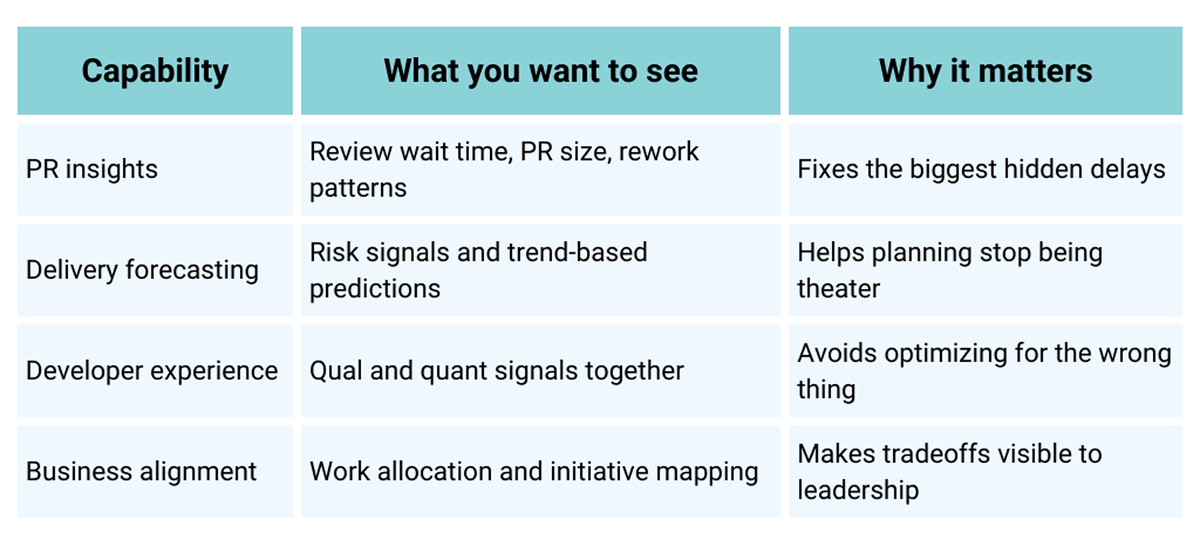
Typo positions itself as an AI engineering intelligence platform focused on turning SDLC data into delivery clarity blockers, risk, and visibility across the workflow.
Where Typo fits best
What to look for in a pilot
LinearB is widely used for engineering metrics and delivery intelligence, with a deep focus on pull request workflows and performance measurement.
LinearB shines when:
Practical wins teams often chase
Jellyfish is built for engineering leaders who need to connect engineering work to what the business needs. It’s not just delivery metrics; it’s planning, allocation, and alignment.
This is a great fit if:
DX focuses on developer productivity by combining quantitative signals with self-reported and qualitative data, which is a big deal, because “developer productivity” is rarely captured well with activity metrics alone.
Also worth noting: Atlassian announced its acquisition of DX, positioning it as part of an engineering intelligence story alongside Jira/Bitbucket and related tooling.
DX is strongest when:
Pluralsight Flow is frequently used to understand throughput trends and flow metrics. It’s especially relevant if your organization already invests in enablement and coaching, since its insights can support improvement conversations if used carefully.
What it’s good for:
Waydev is often chosen because it’s lightweight to adopt, integrates quickly, and provides early visibility into delivery signals across common systems such as Git providers and project management tools.
Waydev also offers an AI-native conversational experience, asking questions and providing insights that lower the barrier for leaders who don’t want to spend time going through dashboards.
Great fit if:
GitClear leans into code change analysis and developer-friendly reporting, helping teams digest code faster, identify rework patterns, and view metrics beyond surface-level activity.
GitClear is a strong choice when:
Quick Comparison: 7 AI Engineering Intelligence Platforms
This table provides a high-level comparison of seven engineering intelligence platforms, showing the types of teams they typically support and the areas where each tool tends to deliver the most value. Use it as a fast starting point before doing a deeper feature and integration review.
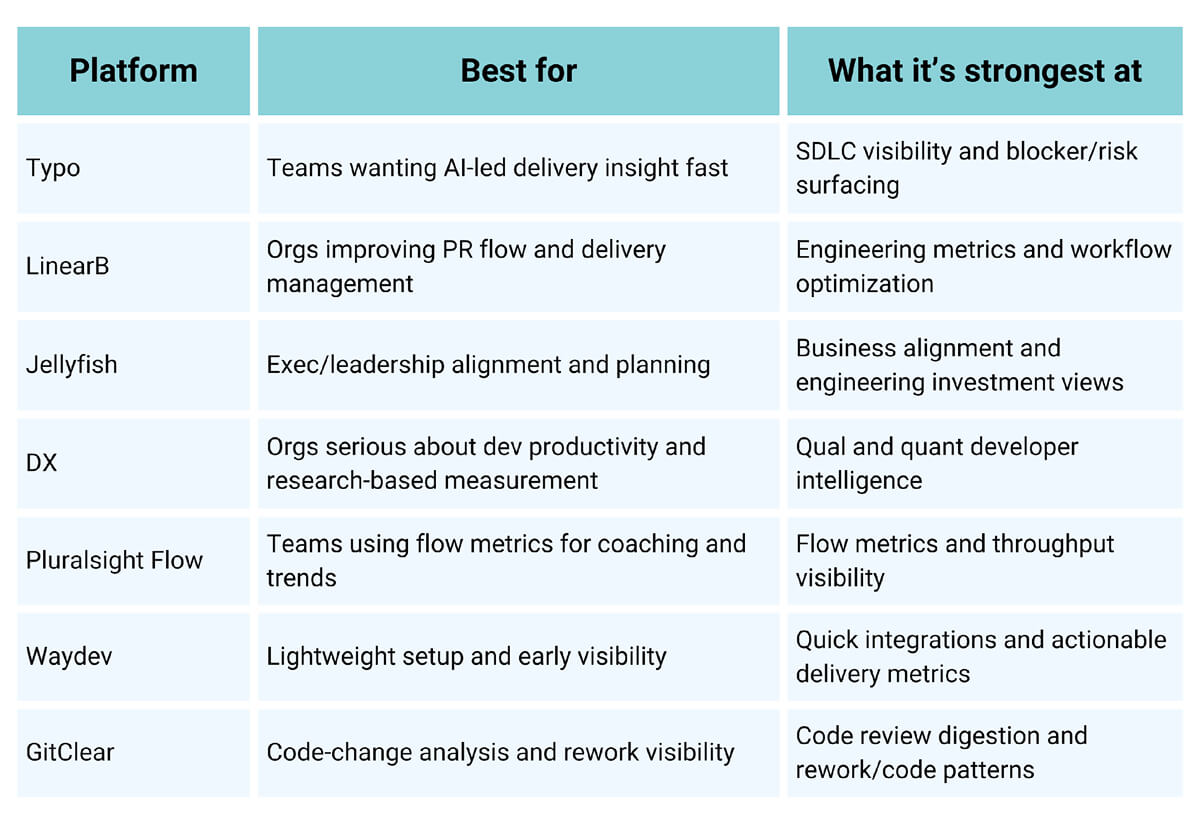
hoosing the “best” tool is less about feature checklists and more about matching your organization’s maturity and pain points.
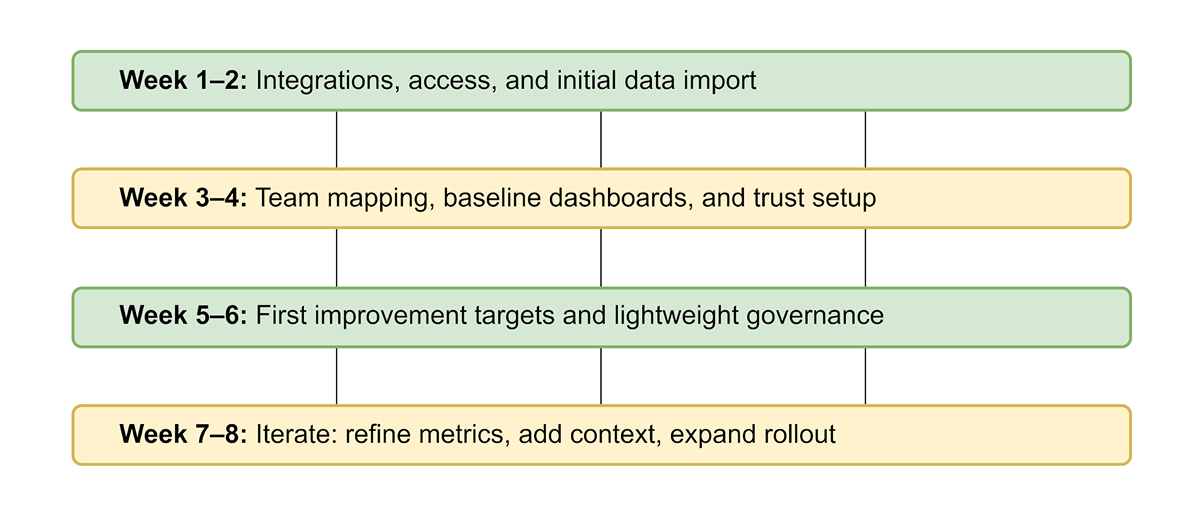
Most rollouts follow a predictable pattern. The main variable is the organization’s complexity: the number of repos, teams, and business units, and how “clean” your Jira and ownership mapping are.
Optional: surveys and qualitative inputs (especially for DX-style measurement).
Example of pulling PR cycle signals (illustrative)
// Example only: pull PRs and compute basic "time to merge" per repo.
// In real rollouts, your platform ingests this automatically, but
// this shows the kind of raw signals these tools are built on.

import fetch from "node-fetch";

async function listMergedPRs(owner, repo, token) {
  const url = `https://api.github.com/repos/${owner}/${repo}/pulls?state=closed&per_page=100`;
  const res = await fetch(url, {
    headers: { Authorization: `Bearer ${token}`, "User-Agent": "metrics-script" },
  });
  const prs = await res.json();
  return prs.filter(pr => pr.merged_at);
}

function hoursBetween(a, b) {
  return (new Date(b) - new Date(a)) / (1000 * 60 * 60);
}

(async () => {
  const prs = await listMergedPRs("my-org", "my-repo", process.env.GH_TOKEN);
  const times = prs.map(pr => hoursBetween(pr.created_at, pr.merged_at));
  const avg = times.reduce((s, x) => s + x, 0) / Math.max(times.length, 1);
  console.log({ mergedPRs: prs.length, avgHoursToMerge: avg.toFixed(2) });
})();
Engineering intelligence platforms is not magic. They won’t fix unclear priorities, messy ownership, or constant thrash on their own.
But they can do something truly valuable: introduce shared visibility to replace wars of intuition. They enable teams to pinpoint flow disruptions, concealment of rework, and the strategic allocation of investment to improve outcomes. When utilized effectively, these platforms foster engineering systems with reduced chaos and surprises, and conversation about improvement rooted in reality.
Engineering intelligence interprets SDLC signals and adds context so the output is actionable (highlighting where flows break and the reasons for delays), rather than merely visual. Analytics, as a discipline, traditionally stops at charts, while engineering intelligence focuses on driving decisions and improvement loops.
Yes, especially lightweight tools or focused rollouts. Smaller teams often benefit from quick visibility into PR flow, batching, and hidden delays. The key is keeping metrics at the team/process level, not individual scoring.
Top platforms focus on team outcomes, transparency, and role-specific views. On the other hand, trust is earned by how the leadership team engages with the data: metrics should elicit questions and drive improvements, not assign blame. (A platform can help, but culture completes the task.)
Typically: source control + ticketing system. CI/CD and incident tooling add richer context, and qualitative inputs strengthen any “productivity” story.
Initial insights can appear in a couple of weeks after integrations, but meaningful, trusted usage, including team mapping, baseline, governance, and the first improvement loop, usually takes 6-8 weeks.
Sign up to our newsletter
By subscribing, you accept our Privacy Policy.