Most engineers didn’t expect AI tools to become part of their daily workflow. Today, coding assistants can suggest entire functions, connect APIs, and scaffold UIs in a few seconds.
This is the core idea of vibe coding: you describe what you want in natural language, and the model generates the initial code. It works well for experiments and side projects, but in an enterprise setting, it immediately raises questions about security, compliance, and long-term maintainability.
Enterprise vibe coding reflects the reality of handling such things. It retains the velocity and creative flow enabled by AI-generated code, while integrating the safeguards, reviews, and governance required to operate dependable, production-quality systems.
What Is Vibe Coding, Really?
In simple terms, vibe coding is an intent-first way of building software.
- You describe what you want in natural language
- AI coding tools generate, refactor, and wire up the code
- You guide, review, and correct rather than type every line
Andrej Karpathy popularized the term to describe “giving in to the vibes” and letting large language models write most of the code, while you steer outcomes.
Analysts expect this style to move from novelty to norm. Gartner-level forecasts suggest that most enterprise developers will be using AI coding assistants in the next few years.
From Vibe Coding to Enterprise Vibe Coding
Left unchecked, vibe coding can create brittle, opaque systems in pile-ups of generated code, untracked dependencies, and security or compliance gaps. That’s why several vendors and practitioners talk specifically about enterprise vibe coding.
Superblocks defines enterprise vibe coding as combining the rapid, intuitive nature of vibe coding with security, governance, and scalability baked in, so internal tools don’t become liabilities.
In practice, vibe coding for enterprise means:
- Guardrails first: Designate policies for data access, secrets, PII, and model usage.
- Standard patterns: Determine approved architectures, templates, and libraries for generated code.
- Traceability: Maintain audit trails of prompts, generated changes, and who approved what
- Production discipline: Define tests, reviews, and release processes that always apply, even if AI wrote 80% of the code
You’re not replacing SDLC discipline; you’re swapping manual low-level work for high-leverage guidance.
Where Enterprise Vibe Coding Actually Fits
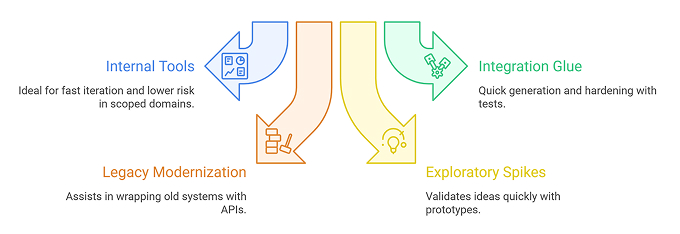
You don’t need to vibe code everything. Most organizations see value in a few sweet spots:
1. Internal tools & dashboards
CRUD-style apps, admin panels, partner portals, and reporting frontends are ideal in clearly scoped domains, fast iteration, and lower-risk applications than customer-facing core flows.
2. Integration & automation glue
ETL scripts, webhook processors, cron jobs, and workflow automations can be generated quickly, then hardened with tests and monitoring.
3. Legacy modernization helpers
AI can assist in wrapping old systems with APIs, generating migration scripts, and gradually refactoring monoliths into services.
4. Exploratory spikes
Need to validate an idea with a working prototype in days, not weeks? Vibe coding tools shine here as long as you don’t let the spike silently become production.
Vibe Coding Tools and Apps: What Should Enterprises Look At?
Vibe coding tools are multiplying fast, but most fit into three groups:
- IDE-native assistants (e.g., Cursor, Windsurf, Copilot-style tools, and AWS Q Developer) live in your editor or CLI and help developers write, refactor, and review code faster without changing their workflow.
- Full-stack app generators (e.g., Clark by Superblocks, Bolt, Replit, and Vercel v0) create end-to-end apps, UI, backend, and basic data models well-suited for internal tools and operational apps.
- Agentic coding platforms, such as Manus-like agents, take higher-level goals (e.g., “Add SSO,” “Refactor X”) and perform multi-step edits with minimal guidance.
When you evaluate vibe coding tools for enterprise use, prioritize:
- Governance: Role-based access, policy controls, and prompt/response logging
- Security & compliance: SOC2/ISO posture, data residency options, secrets handling
- Integration: Support for your Git host, CI/CD, identity provider, and observability stack
- Escape hatches: Ability for engineers to edit, override, or completely own the generated code
Speed is table stakes now; governance is the differentiator.
A Simple Playbook to Start Enterprise Vibe Coding
Start small and intentional.
- Start with one lower-risk, high-impact use case (e.g., a finance dashboard, a partner portal, or ops reporting). The business impact should be visible, but the blast radius should be low.
- Set guardrails: define which data and repos are in scope and which should never be auto-generated (e.g., crypto, billing core).
- Enforce human-in-the-loop: AI code should always be reviewed by a human.
- Instrument results: measure throughput and quality (defects, security issues, rework).
- Codify what works: good prompts, patterns, and tests should be turned into internal playbooks and starter templates.
Final Thoughts
Enterprise vibe coding is not about the buzzword. It’s about accepting the reality that AI will write more and more of your code, and deciding how that happens, whether intentionally, with clear guardrails and governance, or chaotically, one shadow experiment at a time.
If you focus on governance, observability, and outcomes, vibe coding for enterprises can become a force multiplier, letting teams ship faster, experiment more, and avoid burning down their stacks in the process.