As large language models become part of everyday tools, writing assistants, coding partners, and search engines, a new risk has begun to appear: model collapse. This is what happens when AI systems are trained too heavily on content generated by other AI systems. Over time, the “freshness” and diversity of the data erode, and the models slowly lose their ability to produce accurate, creative, or reliable results. Understanding how model collapse works, why it matters, and how to prevent it is essential for maintaining strong AI performance in the future.
What Is Model Collapse?
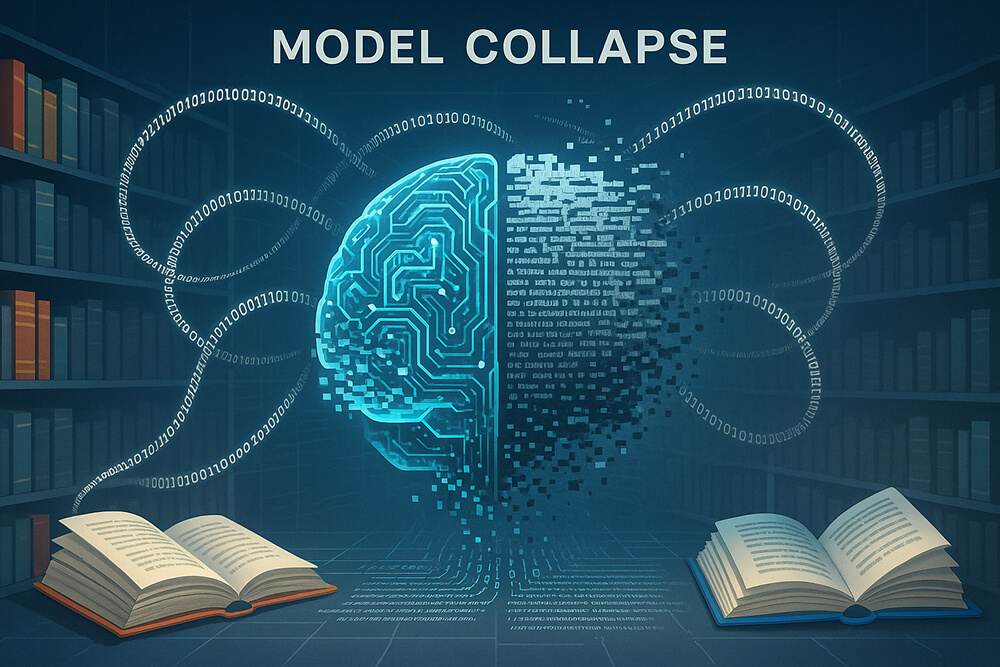
Model collapse describes the progressive decline in quality that occurs when a generative AI system is trained on data generated by other AI systems rather than fresh, human-generated input. Over successive training cycles, errors compound, the model’s representation of the world narrows, and its outputs become bland, biased, or factually unreliable. IBM Research likens this to “AI cannibalism,” in which models increasingly feed on their own synthetic output rather than authentic data sources.
How Does Model Collapse Happen?
- Recursive Training Loops: Web content increasingly contains AI-generated text. When scraped indiscriminately for the next training run, it pollutes the dataset with low-diversity “echoes” of earlier models.
- Sampling Bias: Synthetic text over-represents the most common patterns seen in earlier runs. As unusual phrasing and edge-case facts vanish, the model’s internal distribution shrinks, causing coverage collapse of minority data.
- Error Amplification: Small factual mistakes in synthetic data propagate, get reinforced, and eventually dominate certain niches.
- Gradient Shortcuts: Frontier models optimize for easily learned statistical regularities; when those regularities dominate the corpus, the model stops trying to master harder, nuanced patterns, an effect researchers recently called accuracy collapse when reasoning tasks became complex.
Why Model Collapse Matters
- Product Quality: Applications built on a collapsed core model chatbots, code assistants, and search deliver less reliable answers, harming brand trust.
- Research Stagnation: If every new LLM trains on an increasingly synthetic web, the entire field risks a collective blind-spot where genuine novelty is under-represented.
- Societal Bias: Early loss of distribution tails means minoritized dialects, rare languages, and specialist domains disappear first, entrenching inequity in AI systems.
- Economic Waste: Training frontier models costs millions of dollars and kilotons of CO₂. Grinding through that expenditure only to end up with a worse model is unsustainable.
Ways to Prevent Model Collapse
- Data Provenance Filters: Tag and down-weight AI-authored text during web-scale scraping; many labs now block obvious LLM watermarks before mixing data.
- Human-in-the-Loop “Reality Anchors”: Introduce periodic refreshes of curated, verified human data newswires, peer-reviewed papers, and code repositories to maintain diversity.
- Synthetic-to-Real Ratios: Research suggests that keeping synthetic content below 10–20% of the pre-training corpus sharply reduces degradation.
- Active Tail Sampling: Deliberately oversample rare or low-frequency examples to preserve long-tail knowledge.
- Model-Based Audits: Evaluate each new checkpoint on outlier-heavy test suites (e.g., low-resource languages, adversarial reasoning puzzles) to catch early collapse.
- Retrieval-Augmented Generation (RAG): Pair an LLM with up-to-date external knowledge bases so the generator cites facts rather than hallucinating from a shrinking internal prior.
Future Outlook and Real-World Considerations
Analysts expect the amount of synthetic text on the public web to exceed 50% by 2027. Witness.ai notes that, without stronger safeguards, future models could “inherit blind spots at internet scale.” Yet the outlook is not entirely bleak. New cross-disciplinary efforts combine data-centric AI (provenance tracking, ethical licensing) with algorithmic advances such as reinforcement learning from human feedback (RLHF) and open-source curation communities that share vetted corpora.
Academic debate also continues: a 2025 arXiv paper argues that true collapse is avoidable if we increase dataset size, rigorously track provenance, and raise compute budgets in line with data diversity rather than just parameter count. Meanwhile, regulators for the EU AI Act and US policy drafts already contemplate disclosure requirements for synthetic-heavy training runs, which could nudge the industry toward transparent data supply chains.
Conclusion
Model collapse is not science fiction; it is an empirically observed risk for any AI pipeline that shortcuts real-world data in favor of its own synthetic reflections. Left unchecked, it degrades output quality, reinforces bias, and wastes resources. Fortunately, the same discipline that birthed large language models also offers the tools to preserve them: provenance filtering, diverse “reality anchor” datasets, rigorous evaluation, and hybrid retrieval architectures.
By adopting these best practices today, builders can ensure that tomorrow’s LLMs remain expansive, truthful, and beneficial rather than collapsing under the weight of their own recycled words.