Pair programming is easy to describe but hard to master. Two engineers work on the same problem at the same time. One writes while the other reviews, questions, and thinks a step ahead. Then they switch.
That sounds expensive at first, and in some situations, it is. In others, however, it saves time by cutting rework, reducing review churn, and helping teams avoid bad decisions before those decisions spread through the codebase.
What Pair Programming Looks Like
The usual setup is simple. One person drives the keyboard. The other watches the logic, naming, tests, edge cases, and overall direction. The driver is not a typist. The reviewer is not a spectator. Both need to stay active, or the session will drag.
Good pairing has a certain rhythm. You talk through the change. You write a small piece. You stop. You challenge the assumption. You switch. That back-and-forth is where the value usually shows up.
Pair programming works best when the task has moving parts. A bug with an unclear root cause. A risky refactor. A new service boundary. An onboarding task where one engineer knows the system and the other does not. These are the cases where real-time thinking beats delayed review.
Why Teams Use It
A lot of engineering work fails in small ways before failing in a big way. A weak assumption enters early. A shortcut gets accepted because nobody challenged it at the time. A new engineer works around code they do not fully understand, and the problem stays hidden until later.
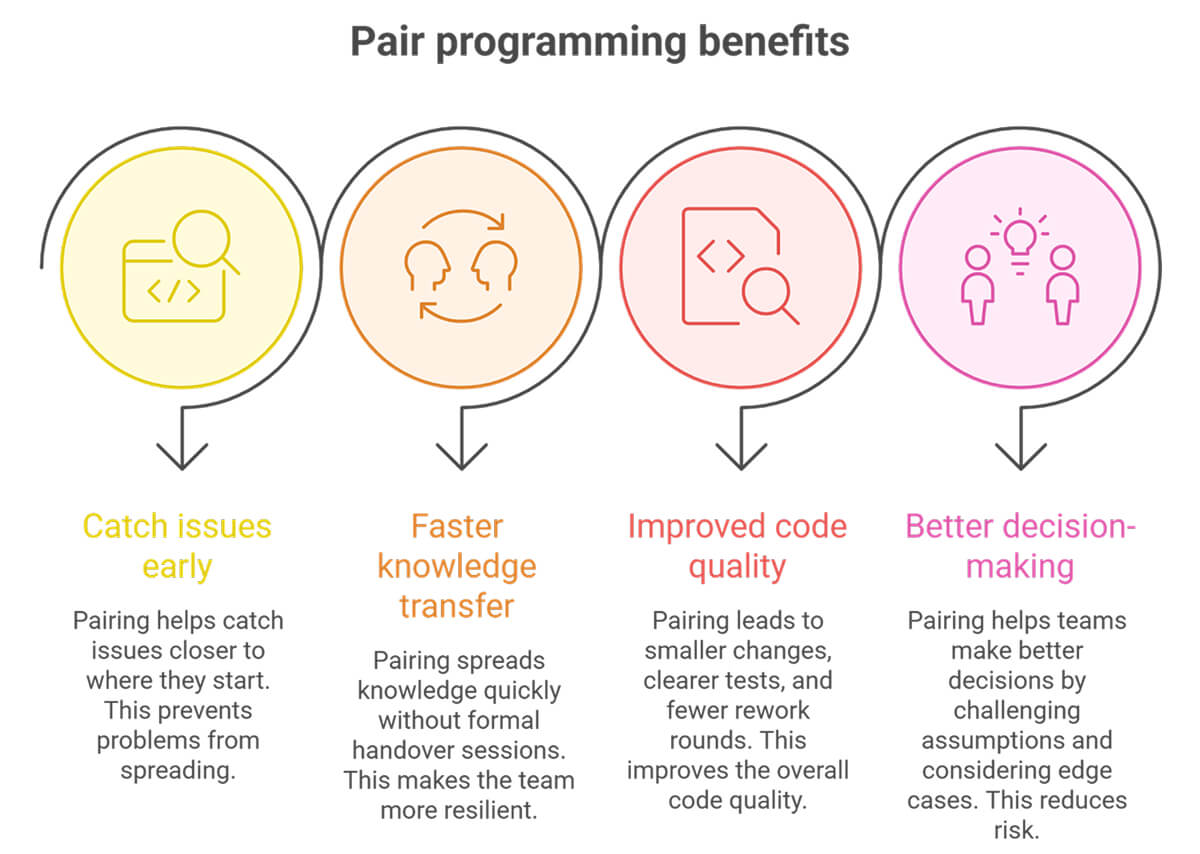
Pair programming helps catch those issues closer to where they start.
It also changes the feedback loop: instead of waiting for a pull request review, questions arise while the code is still taking shape. That often leads to smaller changes, clearer tests, and fewer rounds of rework.
There is another benefit that matters in real teams-knowledge moves faster. When one engineer holds too much context around a service, the release flow becomes fragile. Pairing spreads that context without turning every transfer into a formal handover session.
Where It Works Best
Not every task needs two people. That part is often overlooked. Pairing makes more sense when the cost of getting the change wrong is high, or when the work benefits from shared judgment.
It tends to work well for situations such as:
- tricky production bugs
- complex refactors
- onboarding into unfamiliar code
- risky database or API changes
- critical business logic
- testing and debugging sessions with unclear failure paths
It tends to be less effective for straightforward repetition, isolated cleanup, or work that mostly needs quiet concentration without much decision-making.
This doesn’t mean solo work is better; instead, the approach should fit the task.
Common Mistakes
Most failed pairing sessions fail for ordinary reasons.
- One person dominates the session.
- One person goes passive.
- The task is too simple to justify the cost of two engineers.
- The pair doesn’t switch roles often enough.
- The pair is trying to solve too much in one sitting.
- The session becomes teaching only, with little shared problem-solving.
The biggest reason pairing fails is passivity. Once one person checks out, the session becomes inefficient. You are no longer pairing. You are watching someone work.
Pair programming and Agile teams often run into another issue. They maintain the practice, but lose the intent behind it. It becomes something they do because it sounds collaborative, not because the task needs active shared thinking. That is usually where frustration starts.
Remote Pairing
Remote pairing is normal now. While the mechanics have changed, the core idea has remained the same.
In a remote setup, the pair needs stronger habits around narration and turn-taking. Silence is harder to read on a call than at the same desk. It helps to be explicit. Say what you are checking. Say why you are changing direction. Say when you want the other person to take over.
Remote sessions also go stale faster, and long sessions tend to lose quality. Shorter, focused blocks usually work better, especially for debugging, design-heavy changes, or review cleanup before a merge.
A Simple Way To Keep It Useful
Teams do not need a complicated rule set. A few habits usually suffice:
- Pick tasks that justify two people.
- Define the goal before starting.
- Switch roles regularly.
- Keep both people talking.
- Stop when the session loses focus.
- Use it where risk, ambiguity, or knowledge transfer matter most.
These habits are usually enough to keep the practice grounded.
Paired Programming Versus Code Review
Paired programming and code review solve related problems, but they do not behave the same way. Code review involves delayed feedback, while pairing provides immediate feedback.
Code review works well for broader oversight and asynchronous collaboration. Pairing works well when the change benefits from fast decision-making while the code is being written. Strong teams often use both, depending on the work.
Final Thoughts
Pair programming is not a cure-all, and it is not a waste by default. It is a tool. Used appropriately, it helps teams think more clearly, catch issues earlier, and spread knowledge through real work rather than formal processes. The difference usually comes down to one thing: whether both engineers are fully involved in the problem.