Shift-Left Testing
Shift-left testing means moving testing work earlier in the delivery cycle, rather than waiting until the end. IBM describes it as an approach that emphasizes earlier testing in software development to deliver better coverage, faster feedback, and fewer late surprises. Microsoft’s DevOps guidance makes the same point from a delivery perspective, with a strong push for fast, reliable unit testing close to where code is written.
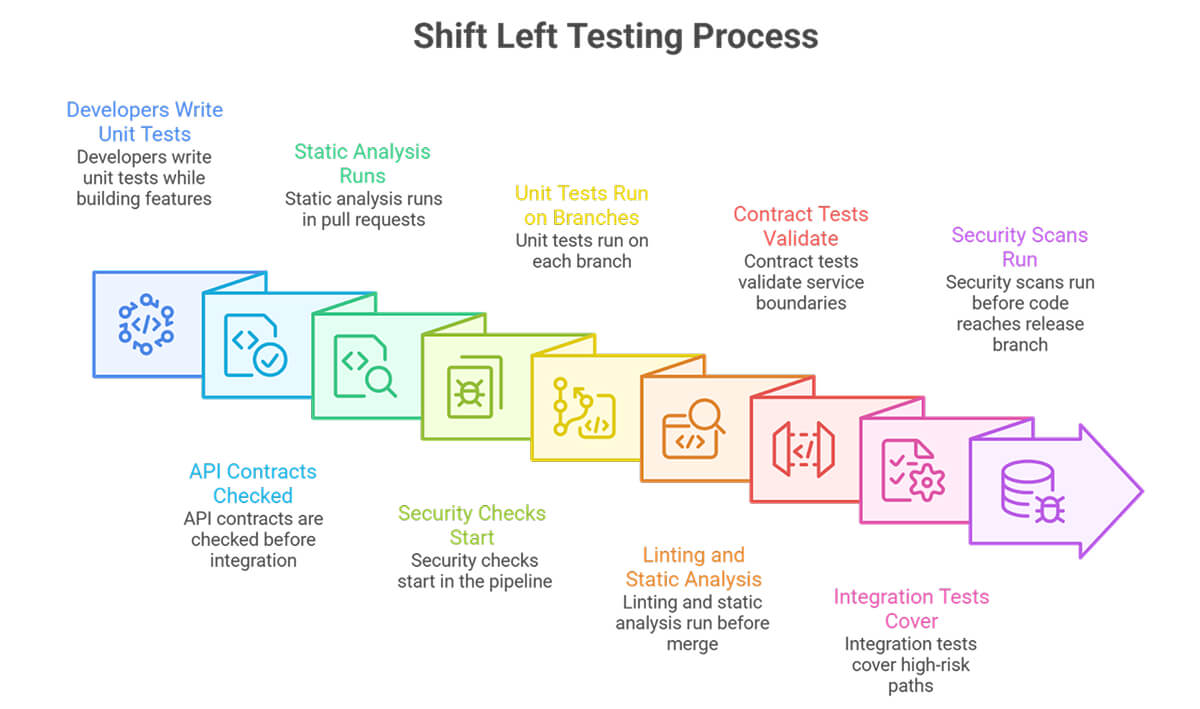
The term sounds simple, though the real value sits in what changes day to day. Teams stop treating testing as a final gate owned solely by QA. Developers write unit tests as they build a feature. API contracts get checked before full integration. Static analysis runs in pull requests. Security checks start in the pipeline instead of after release prep. That is the practical shape of the shift left methodology.
Why Teams Moved This Way
Late testing creates expensive problems. A defect found during coding is usually local and easy to reason about. The same defect found during regression week is mixed in with other changes, more branches, more people, and more pressure. IBM links shift-left work to earlier problem detection and reduced debugging pain later in the cycle. Red Hat makes a similar point for security, saying that earlier checks reduce the rework associated with late vulnerability discovery.
This matters even more in teams shipping small releases often. If a team deploys several times a week, it cannot afford a testing model built around one large end-stage validation phase. The feedback loop needs to stay close to development. Microsoft’s guidance on DevOps testing points in exactly that direction, with frequent checks, strong unit coverage, and a bias toward early validation in the pipeline.
What It Looks Like In Real Delivery Work
A healthy shift-left approach in testing usually starts with small, repeatable checks. Unit tests run on each branch. Linting and static analysis run before merge. Contract tests validate service boundaries. Integration tests cover the highest-risk paths. Security scans and dependency checks run before code reaches a shared release branch. The point is not to mindlessly front-load every test type. The point is to place the right checks where they catch the most risk with the least delay.
A common example is a backend team adding tests around input validation, error handling, and API responses during feature development. Without that habit, the issue may first appear in staging after several services already depend on the new behavior. By then, the fix is larger. More people are involved. The context is weaker. Shift-left software testing helps reduce that chain reaction by shrinking the distance between defect creation and discovery.
What It Does Not Mean
Teams sometimes hear the term “shift left” and assume all testing should happen before release. That is not the idea. Red Hat’s explanation of shift left versus shift right is helpful here. Early testing helps catch defects and vulnerabilities sooner, while later testing in production or near production still matters for behavior under real traffic, at real scale, and with real user patterns. Microsoft’s shift-right guidance also presents the two ideas as complementary rather than competing.
That distinction matters because some problems only show up late. Performance under a production-like load, incident recovery behavior, feature flag rollout issues, and user workflow friction often need later validation. Teams get into trouble when they treat shift-left testing as a complete substitute for production monitoring, staged rollout, or post-release learning. Early checks reduce risk. They do not erase runtime uncertainty.

Where Teams Struggle
The hardest part is rarely tooling; it’s ownership. If developers still assume testing belongs to another team, the practice stays shallow. Test coverage becomes a checkbox. Pipelines fill up with brittle checks nobody trusts. Pull requests pass, yet real defects still leak out because the team has only automated easy cases.
Another common problem is poor test selection. Not every check belongs early. Long, fragile end-to-end suites that run on every commit slow down delivery without providing proportional value. Microsoft’s guidance leans toward fast, reliable tests first, especially unit tests, because those checks provide dense feedback at low cost. Strong shift-left work usually starts there, then adds heavier tests where risk justifies them.
Why It Still Matters
The term has been around for years, yet the pressure behind it has only grown. AI-assisted coding increases output speed, so validation has to keep up. Smaller release cycles leave less time for lengthy manual testing phases. Security expectations are also tighter now, so earlier checks inside normal engineering flow matter more than they used to. IBM’s DevOps material connects continuous testing directly to this earlier-testing principle, and Microsoft still treats it as a core DevOps practice.
Final Thoughts
Shift-left testing is less about a slogan and more about test timing, ownership, and feedback quality. Good teams move useful checks closer to where code changes happen. They do not wait for a late-stage gate to tell them what broke. They also do not pretend that early testing solves everything. The best results come from balancing early validation with strong production learning after release.