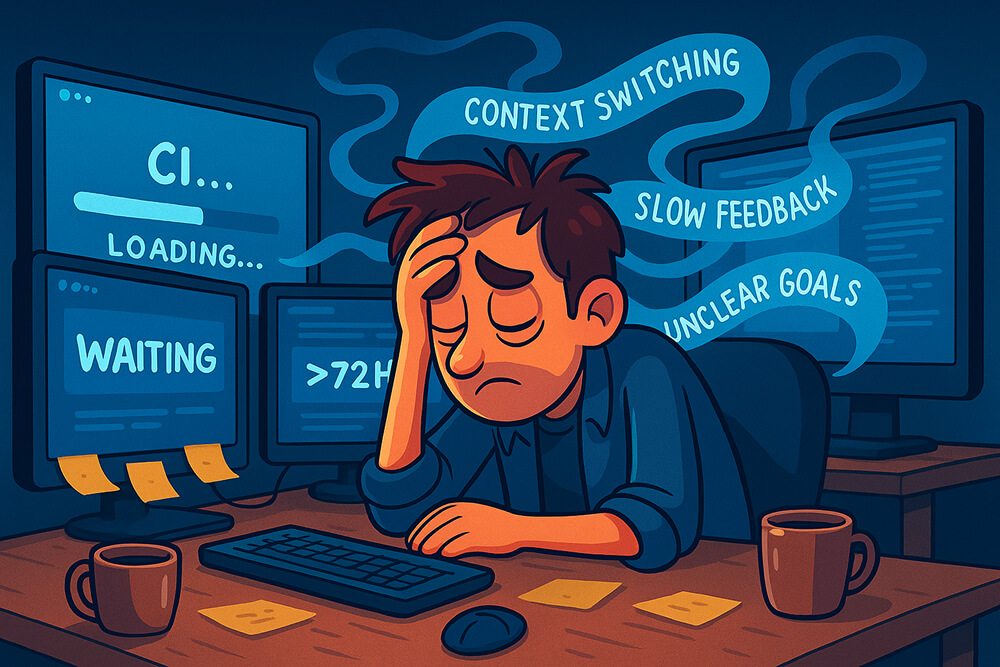
Burnout happens when a programmer’s brain stays under heavy strain for too long. Endless context switching, unclear goals, and slow feedback eat away at focus until even small tasks feel exhausting.
Unlike normal tiredness, a quick rest or a long weekend won’t make software developer burnout disappear. When burnout hits, even easy jobs feel heavy. Developers put off starting, work more slowly, and miss mistakes they’d normally catch right away. So, identifying burnout early is the key to a successful team.
How to Spot Burnouts Early
You can see developer burnout coming if you watch a few clear warning signs in day-to-day work.
Pull request delays
- If a small code change waits more than a day for review or three days to merge, the team’s feedback loop is broken.
- Slow reviews force developers to juggle extra tasks, which drains mental energy.
Big batches of code
- When one pull request suddenly jumps from the usual hundred lines to six hundred, the risk of hidden bugs skyrockets.
- Large batches also scare reviewers, so code sits even longer.
Sluggish continuous integration (CI) tests
- When the test pipeline takes more than ten minutes, developers stare at loading bars instead of writing code.
- This idle time fragments focus and invites multitasking.
After-hours activity
- A steady stream of late-night commits for two weeks is a red flag.
- It usually means the team cannot keep up during normal hours and is paying with personal time.
Why does Burnout Hurt the Whole Team?
When software engineer burnout spreads, both the team’s well-being and the product’s quality suffer.
- Quality drops. More rollbacks, more error pages, and test gaps creep in because tired brains miss details.
- Decisions stall. People postpone design choices to “later,” accumulating decision debt that slows down every future feature.
- Predictability vanishes. Some weeks seem fast, while others crawl. Managers can’t forecast, and customers lose trust.
- Knowledge walks out. When exhausted senior engineers quit, their deep system knowledge leaves with them; new hires need months to fill the gap.
Root Causes for Burnouts and How to Fix Them
Most dev burnout traces back to a handful of common problems, each with a practical fix.
- Cognitive load: How hard your brain must work to finish a task. Break work into smaller pieces and write down clear “done” steps.
- Context switching: Jumping between tasks clears working memory. Let each engineer handle no more than two active tickets at once.
- Flow efficiency: How much of the calendar time is actual coding? Reduce wait time for reviews and expedite CI tests.
- Invisible work: Important chores nobody tracks (mentoring, fixing scripts). Put them on the backlog with owners and estimates.
- Ownership hotspots: A few people must approve everything. Spread review rights and rotate who carries the pager.
Building a Burnout-Resistant Delivery System
Team Habits
Good team routines set the stage for steady focus and steady delivery.
- Quiet hours. Set aside a daily block, such as 1 p.m. to 3 p.m., with no meetings or chat pings, so developers can enter flow.
- Right-sized pull requests. Aim for one purpose, a short description (“what, why, how tested”), and under ~150 lines.
- Firm “Definition of Done.” Code compiles, tests pass, logs and metrics exist, security checks clear, docs updated—every time.
- Safe rollouts. Release behind feature flags. Ramp up from 1% to 100% while monitoring errors, and keep a rollback plan ready.
- Balanced on-call. While someone is on pager duty, lighten their feature load and rotate the role on a weekly basis.
Metrics that Trigger Real Action
A short list of simple numbers will tell you when the system needs attention.
- Lead time to production. Track how long code takes from first commit to live release. Investigate spikes, not people, when this metric rises.
- Change-failure rate. Count how many deployments cause incidents within two days. High numbers require better tests or more refined rollout steps.
- Mean time to recovery (MTTR). Measure hours from alert to fix. Long recoveries indicate unclear runbooks or unreliable rollback tools.
- Time to first review. Reviews should start in hours, not days. If that slips, rearrange reviewer duties.
- Review load balance. Alert if one or two people do most reviews; they will burn out first.
- Noise index. Track pages per engineer per week and celebrate each alert you delete forever.
What Managers Must Do
Leaders can prevent burnout by picking clear priorities and clearing roadblocks fast.
- Limit active priorities to three. Say out loud which features will not ship this quarter; clarity protects focus.
- Remove one blocker weekly. In every 1-on-1, ask, “What’s harder than it should be?” Fix at least one concrete issue within seven days.
Personal Tactics when Stress is High
When stress is high, small personal habits can help prevent it from escalating into burnout.
- Negotiate scope. Trim requirements or split tickets instead of working late.
- Single-task blocks. Spend 90 focused minutes finishing a small feature, then take a short reset. Repeat.
- Micro-rests. Stand up, drink water, and stretch every hour; these tiny breaks refresh attention.
- Find a thinking partner. Pair with a teammate to frame decisions when the path looks fuzzy.
The Takeaway
Burnout is not a flaw in people; it is a sign that the system needs repair. By lowering cognitive load, speeding feedback, making hidden work visible, and sharing operational burdens, teams restore energy and produce steady, high-quality software.