A roadmap stops being useful when it turns into a wish list. Most teams learn this the hard way. The first version looks clean in a planning deck, but once real delivery starts, dependencies emerge, and half the items no longer fit the quarter.
A good technical roadmap is less about drawing a timeline and more about making technical direction visible. Miro describes a technology roadmap as a way to organize initiatives across time horizons and dependencies, while Atlassian frames it as a tool for aligning technology work with business goals. ProductPlan uses similar language and treats an engineering roadmap as a high-level view of plans and objectives rather than a detailed task tracker. (Miro)
What a Roadmap Is For
Teams usually reach for a roadmap because they need one of three things:
- Clear sequencing across technical initiatives
- A shared view for engineering, product, and leadership
- A way to explain why certain work matters before implementation starts
That sounds simple. The difficulty is choosing the right level of detail.
A roadmap should not look like sprint planning; it should not list every ticket, bug, or subtask. Once it gets that granular, it becomes fragile. Every small change forces a rewrite. Then people stop trusting it.
What Belongs In It
A useful technical roadmap usually includes:
- Major initiatives
- Expected outcomes
- Rough timing
- Dependencies
- Risks or constraints
- Ownership at the team or function level
That is enough for a real discussion, but not enough for false precision.
The roadmap should show the migration phases, service dependencies, rollout order, and operational risks. It does not need every schema task or migration script. Those belong elsewhere.
This is where many teams go off course. They try to make one artifact serve every audience. Leadership wants direction. Engineers want implementation details. Product wants timing. Operations wants risk visibility. One board rarely handles all of that well. Better to keep the main roadmap high-level and link supporting plans under each initiative.
How Time Horizons Help
One reason teams like roadmap templates is that they force separation between near-term and longer-term work. Miro’s guidance leans on short-, mid-, and long-term phases because they give structure without pretending later work is fully known. Atlassian also recommends keeping roadmaps clear and actionable rather than overly rigid. (Miro)
That approach works because confidence changes over time.
- Near-term items should be concrete and staffed.
- Midterm items should be shaped and prioritized.
- Long-term items should be directional, rather than committed in fine detail.
If the far side of the roadmap looks as detailed as next month’s work, the team is guessing more than planning.
Technology Roadmap vs. Project Plan
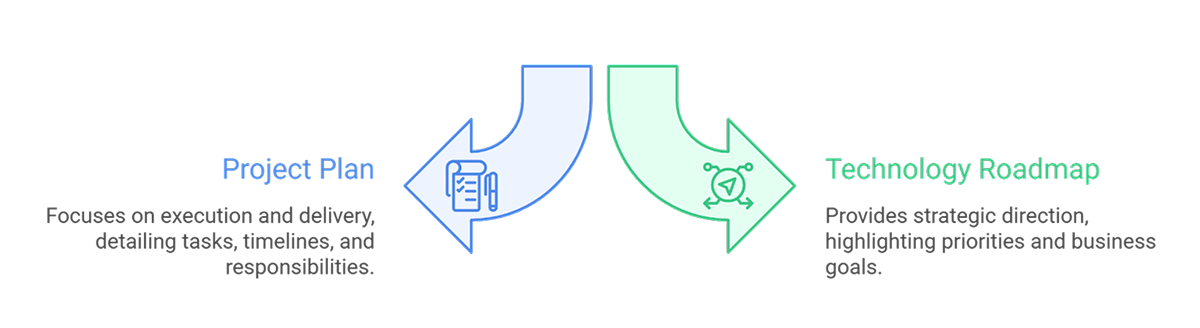
This distinction matters more than people think. A project plan tracks execution. It cares about tasks, dates, assignments, and progress against specific milestones.
A technology roadmap sits above that. It explains where the technical organization is going and why those moves matter. It connects work such as cloud migration, observability upgrades, data platform modernization, test automation expansion, or security hardening to larger business needs.
When teams mix the two, the roadmap gets noisy. Instead of showing direction, it becomes a backlog with colored bars.
How an Engineering Roadmap Should Feel in Real Teams
An engineering roadmap should reflect the shape of actual technical work, not the shape of a presentation template.
That means leaving room for things like:
- Dependency work that unlocks later delivery
- Reliability work with no visible feature output
- Architecture cleanup that reduces delivery drag
- Security or compliance work with hard deadlines
- Platform investments whose value appears through other teams
This matters because engineering work rarely breaks down into neat feature buckets. Some quarters are heavy on delivery. Some are heavy on stability. Some are spent paying off decisions that looked fine a year ago but are now slowing everything down.
A roadmap that shows only customer-facing items often hides too much of the real cost.
Common Mistakes
The most common problems are familiar:
- Too much detail, which makes the roadmap brittle
- Too little explanation, which makes prioritization look arbitrary
- Dates presented as commitments when they are still assumptions
- No visible link between roadmap items and business or operational goals
- No updates after the initial planning cycle
That last one is especially common. A stale roadmap is worse than no roadmap because people keep reading it as current.
Review rhythm matters. ProductPlan and Atlassian both stress the strategic role of roadmaps rather than treating them as static plans. They are supposed to be maintained and used for communication, not parked after kickoff.
A Practical Way to Build One
A simple working flow looks like this:
- Start with business or operational goals.
- Group technical initiatives under a few clear themes.
- Order the work by dependency and expected impact.
- Use broad time horizons rather than precise, distant dates.
- Add ownership and major risks.
- Review monthly, reshape when needed.
If the roadmap needs constant explanation in every meeting, the structure is probably too vague. If nobody can adjust it without reopening a giant planning document, it is probably too rigid.
Final Thoughts
A roadmap is useful when it helps people make better decisions before work starts and during delivery. That is the real test.
The best ones are plain. They show direction, tradeoffs, and timing without pretending the future is fully known. If your team can look at it and understand what matters now, what comes next, and what is still uncertain, the roadmap is doing its job.