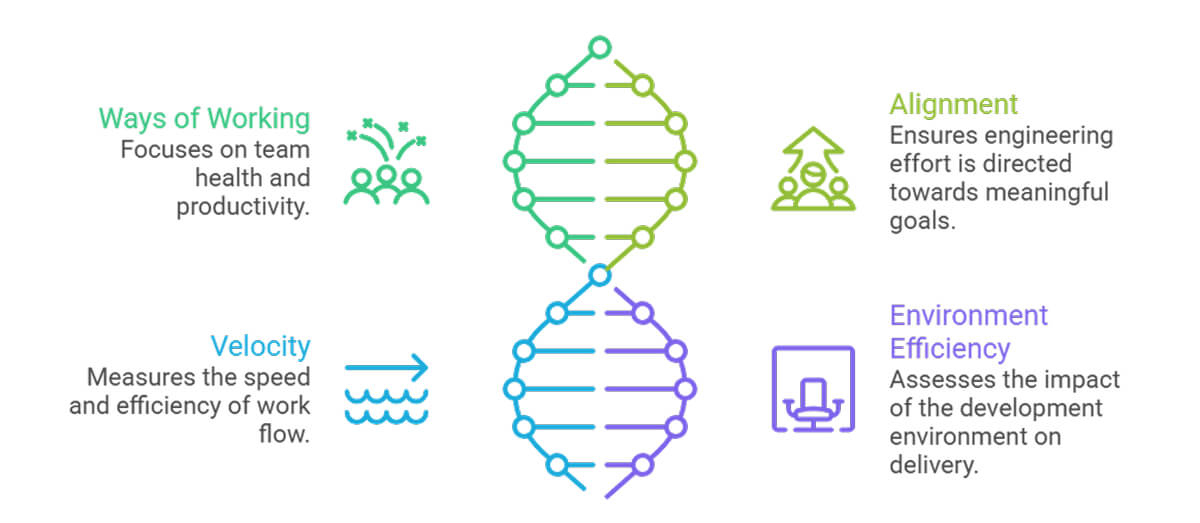
The WAVE framework is a way to organize engineering team metrics, so leaders are not staring at disconnected dashboards and guessing what matters. It breaks down engineering effectiveness into four interconnected areas: Ways of working, Alignment, Velocity, and Environment efficiency. The point is not to collect more data. The point is to understand which conditions help delivery and which ones quietly slow it down.
That matters because most engineering KPIs fail in common ways. Teams measure what is easy to count, such as PR volume, story points, or bug totals, then struggle to connect those numbers to real delivery quality or business value. The WAVE model seeks to address that by treating engineering as a sociotechnical system rather than a purely mechanical output machine.
What WAVE Encompasses
WAVE gives teams four lenses:
- Ways of Working
- Alignment
- Velocity
- Environment Efficiency
Each one addresses a different kind of signal, but the framework works best when teams read them together rather than in isolation.
Ways of Working
Ways of working focuses on the human side of delivery, focusing on practical issues rather than vague cultural ideas. Can engineers get uninterrupted time for deep work? Is team health stable? Are AI tools being used with enough clarity and consistency to help rather than confuse? In the WAVE model, these are upstream conditions that shape how well technical work happens later.
This is where many software engineering KPIs fall short. They track shipping speed, but not whether the team is working in a way that supports steady delivery. A team with constant interruptions, unclear AI guidance, and weak collaboration can still push code for a while, but it usually gets expensive later.
Alignment
Alignment asks whether engineering effort is going toward work that matters. The framework looks at factors such as effort allocation, planning quality, and the speed of the user feedback cycle. If a team is spending most of its time on unplanned work, technical debt firefighting, or requirements churn, raw throughput numbers will hide more than they reveal.
This is one reason the wave framework is more useful than a simple delivery dashboard. A team can look busy and still be poorly aligned. Plenty of work completed does not automatically mean meaningful progress. If user feedback arrives slowly or planning quality is poor, the system drifts even when output stays high.
Velocity
Velocity in WAVE encompasses more than just sprint points. It looks at how work actually moves through the system. That includes PR cycle time, PR velocity, issue velocity, deployment frequency (where available), handoffs, and review delays. The focus is flow, not ceremony.
This part is useful because teams often treat engineering KPIs as if one speed number tells the entire story; it does not. A team can have acceptable throughput and still lose days in review queues, cross-team handoffs, or oversized pull requests. WAVE treats those delays as first-class signals instead of background noise.
Environment Efficiency
Environmental efficiency examines whether the surrounding system supports or impedes delivery. In the WAVE model, this includes recovery, code quality, and friction. Recovery pulls in resilience signals such as lead time for changes, change failure rate, and mean time to recover. Code quality includes bug rates, customer-found defects, complexity, and support escalations. Friction looks at where work spends time waiting and where tooling or process creates drag.
This is where the framework becomes useful for diagnosis. If the flow slows down, the answer isn’t always within the delivery process itself. Sometimes the real problem is brittle quality, weak recovery, or a development environment full of waiting and rework. The framework keeps those causes visible.
How to Use it Effectively
The practical use of WAVE is not to build a single giant score and manage it in a spreadsheet. It functions better as a review framework.
A simple pattern looks like this:
- Start with one or two signals per dimension.
- Review trends at the team level, not the individual level.
- Compare a team against its own history.
- Use bad movement as a prompt for diagnosis, not as a basis for blame.
- Change only a few things at a time.
That last part matters. Teams often overload their metric system. Too many measures generate noise. WAVE is most useful when each dimension points to a single real conversation about delivery conditions.
Common mistakes
The usual mistakes are predictable:
- Using WAVE to rank individual engineers
- Treating the four dimensions as separate scorecards
- Chasing activity instead of outcomes
- Comparing teams with very different contexts
- Measuring everything and improving nothing
The WAVE framework works best when it’s used as a diagnostic. It shows where the system is under strain. Once leaders start using it as a pressure tool, the quality of the data usually gets worse.
Final thoughts
WAVE is useful because it gives the engineering team metrics a shape. Instead of treating delivery, planning, collaboration, and quality as separate reporting threads, it puts them into a single model. That does not make measurement simple. It makes it more honest.
For teams trying to build a cleaner set of engineering KPIs, that is the real value. The framework does not ask for a single number to explain the whole system. It provides you with four places to look, and that is usually closer to how engineering performance actually behaves.