How can engineering intelligence platforms improve developer experience without micromanagement?
Written by

Status
answered
Written by
Status
answered
Software teams juggle sprawling codebases, constant releases, and stiff competition. Leaders crave visibility, but classic tactics, such as daily status pings, granular time tracking, and lurking in pull requests, feel like micromanagement and drain morale. Engineering intelligence platforms (also called developer intelligence tools) promise a better route: objective, aggregated engineering insights that reveal friction and guide action while preserving autonomy.
Healthy cultures optimize flow deployment frequency, lead time, and change-failure rate, not raw output per engineer. The most helpful platforms default to team- or service-level views, mirroring DORA’s proven developer experience metrics. Spotlighting a sluggish review queue invites a group fix instead of singling out a coder.
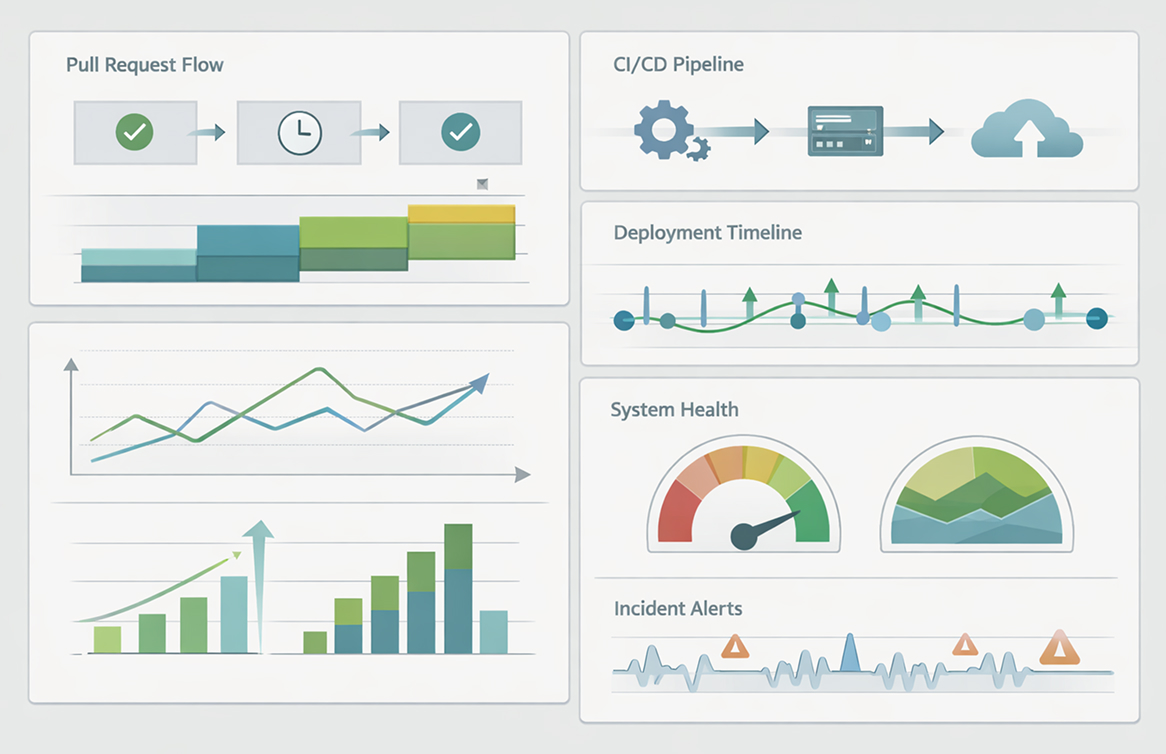
Developers rarely benefit from “Eve merged 27 PRs.” They do need to know reviews now average 2.4 days versus the 1-day goal. Good platforms transform Git, CI/CD, and incident logs into actionable signals such as “Median review time up 40%; consider smaller PRs or more reviewers.” By framing insights in terms of next steps, dashboards inspire rather than police.
A platform succeeds when engineers see it as their tool. Look for:
Because developers drive the loop, insight replaces oversight.
Publish which data sources are tapped and how each metric is calculated. Then map metrics to what matters: reliability, customer delight, innovation cadence. When engineers understand why lead time matters to users, they embrace alerts that surface regressions.
Numbers tell only half the story. Many platforms now embed one-question surveys at the end of a sprint, such as “How much flow time did you get?”, and correlate answers with objective latency. A jump in lead time paired with low “clarity of requirements” scores points to product-engineering misalignment, not coder sluggishness.
Treat every metric as a hypothesis engine. If review time spikes, run a two-week experiment: adopt pair reviews for thorny changes, then watch the dashboard. Because the team owns both the experiment and the data, improvement feels empowering rather than supervisory.
Stating these guardrails up front reassures developers that intelligence ≠ surveillance.
At Acme FinTech, adopting an Axify-style platform revealed that only 35% of pull requests were merged within one day. The team introduced smaller PR templates and asynchronous review rotations. Within a quarter, median review time fell to six hours, deployment frequency doubled, and survey scores for “ability to focus” rose 18%. No extra stand-ups were added; the data itself guided change.
Tool menus are crowded. Before buying, pilot contenders with a small squad and evaluate three dimensions:
Selecting a platform that scores high on all three keeps the focus on enablement, not enforcement.
A successful rollout shows up in places dashboards can’t fully capture: fewer context-switching complaints, faster onboarding of new hires, and more creative time for architectural spikes. Periodic anonymous feedback and skip-level one-on-ones remain essential. Numbers guide progress, but conversations confirm that developers feel the difference.
Engineering intelligence platforms convert scattered signals into cohesive engineering insights, enriching the developer experience instead of eroding it. When they emphasize system flow, transparent metrics, and developer-controlled feedback loops, they foster a culture where insight, not micromanagement, fuels continuous improvement, enabling engineers to deliver better software with confidence and autonomy.