How do Internal Developer Portals benefit software development?
Written by

Status
answered
Written by
Status
answered
Modern engineering teams juggle dozens of tools, pipelines, and cloud accounts. While internal developer platforms (IDPs) abstract that plumbing, developers still need a clear doorway into it. Internal developer portals provide a self-service “one-stop shop,” turning provisioning scripts, CI/CD, observability, and documentation into a few clicks. The portal’s UX layer becomes the developer’s home base, while the platform enforces standards behind the scenes. As such, many organizations now view the portal itself as their primary platform for the developer experience.
Below are six tangible ways a portal accelerates software delivery.
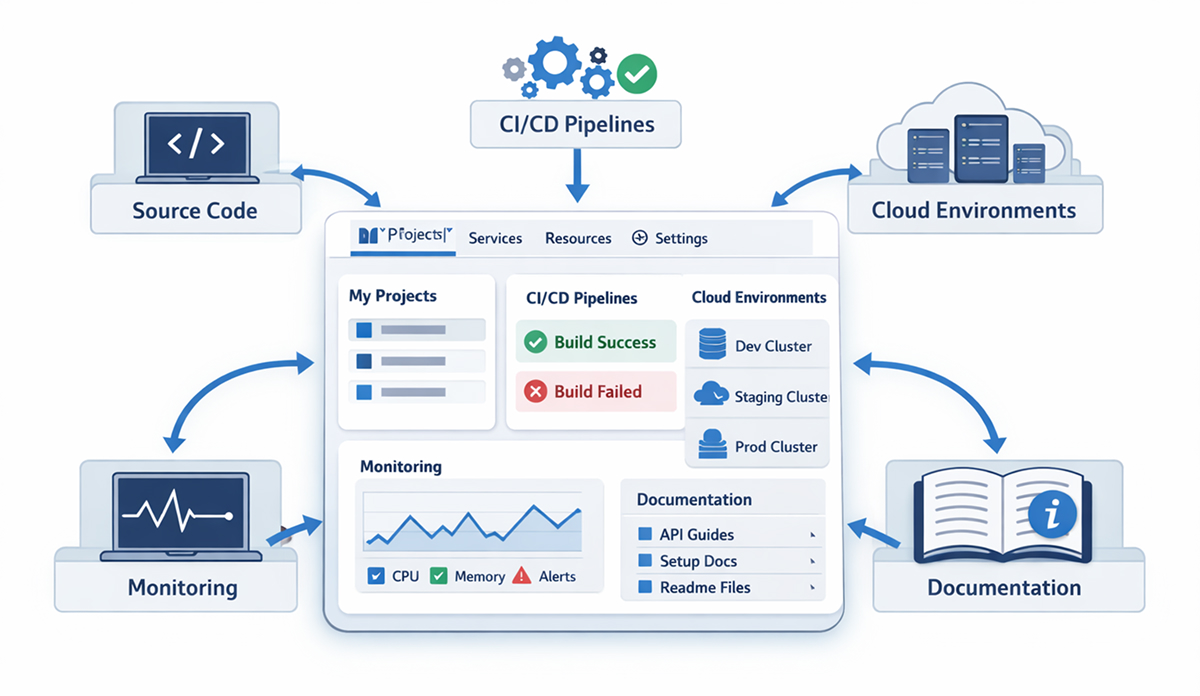
Instead of filing tickets, engineers open the portal, pick a language-specific template, fill a short form, and click deploy. The platform spins up a Git repository, a container registry, an environment, and a monitoring dashboard within minutes. This dramatic reduction in wait time fuels experimentation and the use of feature flags. Cycloid reports a 70% reduction in support tickets for new service provisioning following the introduction of its portal.
Scattered APIs, golden paths, and runbooks become a searchable catalogue of components, contracts, and owners. The portal surfaces “how-to” snippets, environment variables, and security guidelines right where developers are working. New hires can spin up a sandbox and read service docs on day one rather than shadowing teammates for weeks. Port.io calls it the ability to “find, access, understand and manage anything in the SDLC with ease,” directly translating to fewer interruptions and quicker delivery.
The portal drives the IDP to spin up clusters, pipelines, and policy checks via versioned templates. Every microservice is born with the same observability hooks, RBAC rules, and SRE-approved liveness probes. Consistency slashes “works on my machine” incidents and simplifies audits because artefacts are predictable. Atlassian notes that standardized environments reduce deployment issues and speed debugging, while Octopus reports that blueprints eliminate drift across dev, staging, and prod.
Guardrails such as vulnerability scans, cost quotas, and approval gates run automatically inside the self-service flow. Security teams can encode policies once on the platform and trust that every deployment complies with them. The portal also maintains a real-time audit trail of who created which environment, what version was promoted, and which checks ran. CloudBees highlights that developers “focus on development without worrying about infrastructure,” while policies are enforced invisibly.
Each catalogue entry is tagged with owners, links, and SLAs, turning the portal into a living system map. Dependency graphs help product managers see blast radius, and engineers locate domain experts in seconds. Red Hat calls this a “single pane of glass” that aligns cross-functional teams. On-call engineers jump straight from an alert to the owning squad’s chat or runbook, cutting mean time to resolution and reducing burnout.
Because the portal mediates every deploy and environment request, it can surface metrics such as lead time, deployment frequency, change-failure rate, and MTTR, and, in some portals (e.g., Cycloid), even energy-consumption data. Platform teams translate these metrics into service-level objectives for the developer experience and iterate accordingly. Getport.io’s 2024 survey found that 50% of companies already run a portal and 35% plan to adopt one within a year, citing measurable DX gains
An internal developer portal is the human-centred layer atop internal developer platforms. By enabling rapid self-service, unifying institutional knowledge, enforcing policy, and illuminating performance, portals help teams ship reliable software faster and happier. For organizations aiming to stay competitive in 2026 and beyond, a robust, data-driven portal is no longer a “nice-to-have”; it is the logical next step in modern engineering.