In most teams, something goes wrong before anyone asks about the audit trail. A config change, access misuse, or a research project result is questioned. Then everyone starts asking the same thing: Who did what, where, and when?
That is precisely what audit trailing solves. An audit trail gives you a clear, time-ordered record of actions across your systems or studies. In software, it supports security, incident response, and compliance. In qualitative research, it shows how you moved from raw observations to final findings.
In this article, we’ll look at what an audit trail is, how it differs from regular logs, why it matters in both software systems and qualitative research, and what to look for in audit trail software.
What Is an Audit Trail?
At a basic level, an audit trail is a chronological record of events:
- Who performed an action
- What they did
- Where it happened (system, resource, project)
- When it happened (timestamp)
Security and logging guides describe audit logs as essential for tracking user actions, system changes, and events across your environment. Splunk+1 NIST even differentiates between a simple log (events from a single component) and an audit trail, which includes the full history of an event, often pieced together from multiple logs.
You can think of it as version control for behavior, not just code. Git shows how the code evolved; the audit trail shows how the system was used and changed.
Why Audit Trailing Matters in Software Systems
Security and Compliance
Modern regulations (GDPR, HIPAA, SOX, ISO 27001, SOC 1, etc.) require you to demonstrate that you understand what is happening with sensitive data and critical systems. Strong audit trails help you:
- Detect suspicious access or changes.
- Prove to auditors that controls are actually enforced.
- Reconstruct what happened during a breach or incident.
Guides on audit logging and compliance emphasize that a chronological record of actions is non-negotiable for serious B2B or regulated software.
Observability and Incident Response
When production goes sideways, the audit trail often answers questions that logs alone can’t:
- Who changed this IAM permission yesterday?
- Who disabled that security rule?
- Which admin created this new project or token?
Tools like SonarQube Enterprise, for example, provide dedicated audit logs for security-related changes (e.g., user accounts, permissions, authentication settings) so admins can download and analyze the full trail.
Accountability and Trust
There’s also a cultural effect. When people know their actions are recorded, they are more likely to follow policy and less likely to quick-fix something in production without leaving a trace. NIST explicitly notes this behavior-shaping benefit of audit trails.
Audit Trail vs. Log: Are They the Same Thing?
They overlap, but they’re not identical.
Logs
- are generated by a particular element (Web Server, Database, App).
- concentrate on technical happenings (errors, performance, requests).
Audit trails
- provide an aggregated perspective that reconstructs who did what across systems.
- are usually constructed from various logs, plus metadata and context.
Good audit trail software usually sits on top of existing logging infrastructure (e.g., SIEM or log management tools like Splunk) to provide a higher-level view and searchability.
Audit Trails in Qualitative Research
The same concept appears in a completely different context in qualitative research.
An audit trail in qualitative research is a comprehensive account of how the study was carried out, including data collection and coding decisions, protocol changes, and the researcher’s thoughts.
Why is this important?
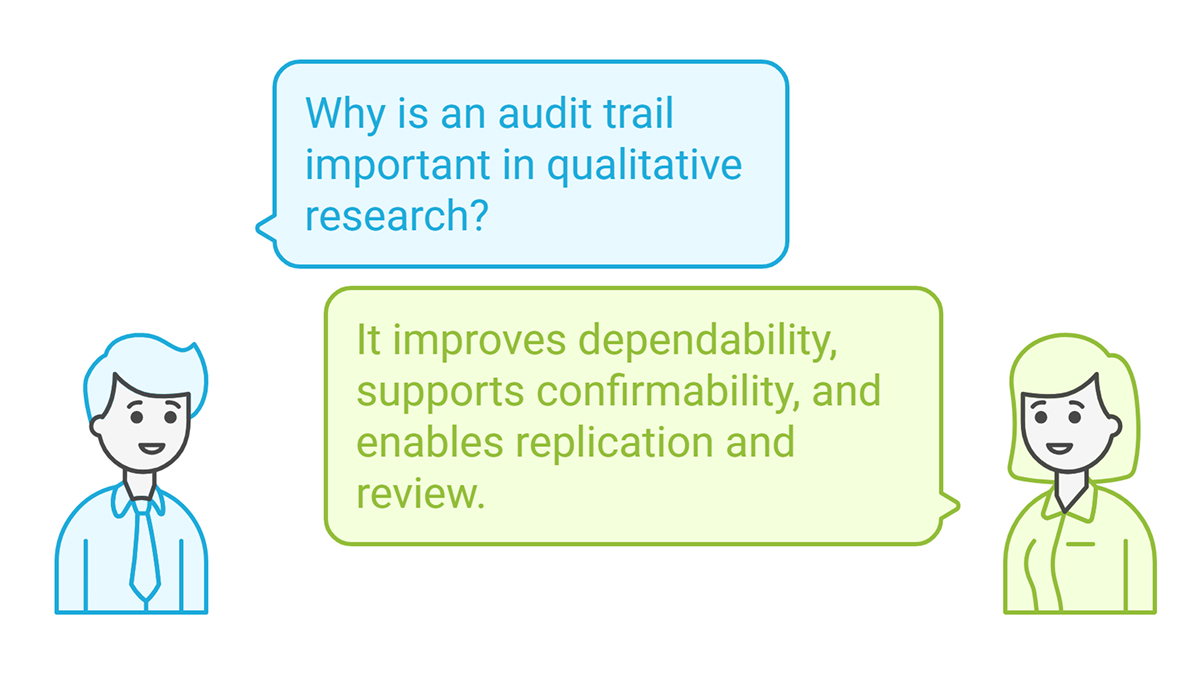
- It improves dependability: others can see how you moved from raw data to findings.
- It supports confirmability: reviewers can verify that results derive from participant data rather than from researcher bias.
- It enables replication and review: another researcher could follow your steps and see if they reach similar conclusions.
For technical teams, this matters if you run user interviews, UX studies, or developer research. Keeping a research audit trail (i.e., notes, coding decisions, tool outputs, protocol changes) gives your product and engineering teams greater confidence in the insights they use to make decisions.
Final Thoughts
Audit trailing is about keeping a trustworthy history of what happened. In software, it helps you spot suspicious activity, handle incidents, and meet compliance needs. In qualitative research, this makes your process transparent and your findings more credible, allowing you to quickly answer who did what, where, and when. As a result, your systems and research are much easier to trust.