Sprint velocity is one of those Agile terms people use loosely until planning starts going wrong. Then everybody wants a sharper definition. Velocity is the average amount of work a Scrum team completes during a sprint, usually measured in story points or hours, and is used for forecasting future work. Scrum Alliance defines velocity similarly and stresses that its predictive value depends on a stable team composition over time.
That makes sprint velocity useful, though only when teams treat it as a planning signal. Once leadership turns it into a productivity scoreboard, the number starts losing meaning. Story points get inflated, work gets split oddly, and the metric stops reflecting the reality of delivery. The Scrum Alliance explicitly warns against treating story points and velocity as productivity evaluation metrics for leadership.
What Does Sprint Velocity Mean?
In plain terms, sprint velocity is the amount of work a team completes in a single sprint, typically measured in story points. If a team completes 28 story points this sprint, 32 in the next, and 30 in the one after that, its recent delivery pace sits around 30 points per sprint. Atlassian’s velocity guidance and Jira documentation both frame velocity as a way to predict how much work a team is likely to finish in future sprints, with accuracy improving after several sprints.
Sprint velocity discussions belong in planning and retrospectives, not in performance reviews, because the number helps answer a single, narrow question: Given how this team has been working, what amount of work is reasonable to pull into the next sprint?
How Teams Calculate Sprint Velocity
Most teams total the story points of completed items at the end of each sprint. Only work that meets the team’s “definition of done” should count. Partial work is not included. Re-estimating midway to make the sprint look better defeats the whole exercise.
A simple example might look like this:
- Sprint 1 – 24 points completed
- Sprint 2 – 30 points completed
- Sprint 3 – 27 points completed
- Sprint 4 – 29 points completed
Average velocity: 27.5 points per sprint
This average gives the team a rough planning baseline. Atlassian’s Scrum metrics guidance notes that teams usually need a few sprints together before the numbers start becoming useful. The Scrum Alliance makes the same point in its material on velocity and capacity planning.
What Leads To Changes
Sprint velocity changes can happen for several common reasons. The team size changes. A sprint contains a holiday. Production incidents consume half the week. The backlog includes more unknowns than usual. None of this is strange.
Common factors include:
- Team composition changes
- Time off and public holidays
- Unplanned support work
- Poorly refined backlog items
- Large stories with hidden dependencies
- Weak Definition of Done discipline
This is why Agile development velocity works better as a trend than as a target. One sprint alone tells very little. Six to eight sprints tell a better story.
What Sprint Velocity Is Not
Sprint velocity is not developer output. It is not engineering efficiency in any broad sense. It is not comparable across teams.
A backend platform team, a mobile team, and a data engineering squad may all estimate differently, work at different levels of uncertainty, and carry different operational loads. Comparing their velocities as if the numbers were on a single universal scale makes little sense. The Scrum Alliance glossary states that sprint velocity reflects work completed during a team’s own sprint or iteration. Atlassian positions it as a team forecasting tool, not a cross-team ranking model.
This is a point that many organizations miss. The metric has value only within the team that produced it.
Where Teams Misuse It
The most common mistake is chasing a higher number.
Once teams feel pressure to raise velocity, estimation starts drifting. An eight-point story becomes a thirteen-point story. Small bugs get oversized. Work gets closed early and cleaned up later. The chart may look healthy, but the delivery quality may not.
Other common mistakes show up quickly:
- Using velocity to rank teams
- Treating unfinished work as completed
- Ignoring spillover from unplanned support
- Expecting the same number every sprint
- Using velocity without backlog refinement discipline
Too often, the metric gets blamed for behavior problems that came from management pressure, not from the metric itself.
How To Use It Effectively
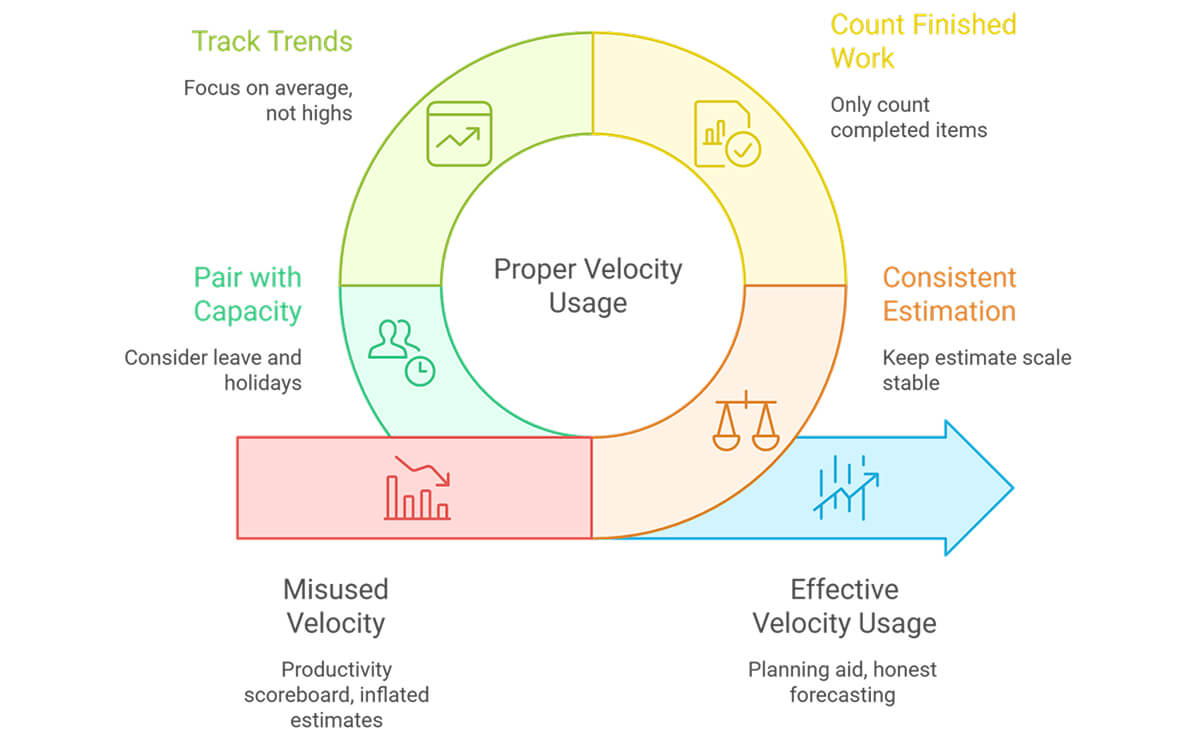
Used properly, velocity helps with planning, forecasting, and setting expectations.
A practical approach looks like this:
- Use the last few sprints, not one sprint.
- Pair velocity with capacity, especially during leave-heavy periods.
- Track trends, not vanity highs.
- Keep the estimation scale consistent.
- Review outlier sprints before relying on the average.
Atlassian’s Scrum metrics material ties velocity closely to capacity and planning, while Jira’s velocity report focuses on how much work was delivered each sprint to help teams decide what is feasible next. That is the useful lane for this metric.
If a team usually lands between 26 and 30 points and the next sprint includes two engineers on leave plus a risky migration task, planning for 30 is a fantasy. Planning for 20 to 24 may be more realistic. That honesty matters more than optimism.
Why It Still Matters
Some teams treat velocity as outdated because delivery work now spans product, platform, support, and operations. The criticism is fair when teams expect too much from one number. Velocity alone does not explain quality, customer impact, or flow bottlenecks.
Still, it remains useful inside Scrum when the question is simple and local. How much estimated work does this team usually finish in a sprint? Atlassian still includes velocity among core Scrum metrics for forecasting, and the Scrum Alliance continues to position it as a practical planning measure when used with stable teams and consistent estimation.
Final Thoughts
Sprint velocity is a planning aid. Nothing more. Nothing less. When teams keep the estimate scale stable, count only finished work, and read the number as a trend, velocity helps planning feel less arbitrary. When organizations stretch it into a productivity score, it becomes noise. That is usually where trouble starts.