Bito AI feels less like a general chat tool and more like a review layer embedded in normal engineering work. The product is centered on AI code reviews across Git, IDEs, and the CLI, with a broader context layer, AI Architect, that incorporates codebase structure and operational history.
That makes it more useful as a workflow tool than as a pure assistant. The real question is not whether it can generate code on request. It is whether it can help teams review changes with better context and catch issues before a pull request becomes a long back-and-forth.
What is Bito AI?
Bito AI is an engineering product built around code review and contextual understanding of a codebase. Its current product is split between the AI Code Review Agent, which works in Git provider workflows, IDEs, and the command line, and AI Architect, which builds a knowledge graph from repositories, modules, APIs, and issue-tracker history, such as Jira.
In practice, that means Bito is trying to do more than just comment on a diff. It is designed to understand how a change connects to the rest of the system, which ticket it relates to, and, in more robust setups, which nearby modules or services may also be affected. That gives the product a more grounded feel than a coding assistant that only sees the file in front of you.
Key features
The most useful Bito AI features are those that fit quietly into the work developers already do. Review a pull request, check staged changes locally, run a review from the terminal, or validate a pull request against a Jira ticket. None of that requires inventing a separate process, which is usually where engineering tools lose people.
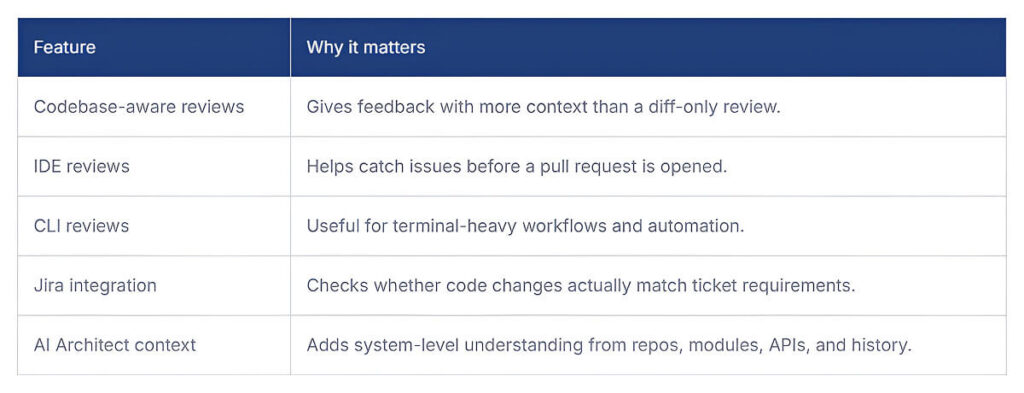
A practical strength here is coverage. Bito supports GitHub, GitLab, and Bitbucket for Git reviews, while the IDE and CLI options make it easier to use the same review logic earlier in development. That matters because review quality usually improves when feedback is provided before the formal review stage, not after.
Who is using Bito AI?
Bito looks best suited to teams that already live in pull requests and want review feedback to be more consistent. That includes product teams working across multiple repositories, platform teams focused on review quality at scale, and engineering organizations that already manage work in Jira and want better alignment between tickets and implementation.
There is also a broader fit for mixed environments. The docs position the CLI and integration model in a way that makes sense for teams that do not work from a single editor or that need reviews in CI/CD-style flows and terminal-heavy setups. While an individual developer can still use it, the stronger story is clearly team review rather than solo prompting.
What makes Bito AI unique?
The most distinctive part of Bito AI is not the assistant layer. It is an attempt to make review feedback depend on the system context rather than only the local code context. Bito’s AI Architect is described as the context layer for the software development lifecycle. It builds a knowledge graph from the codebase and operational history, then feeds that context into reviews and agent workflows.
That is where the product becomes more interesting than a typical coding assistant label suggests. Bito AI code review is meant to answer bigger questions, such as whether a change aligns with the intent of a Jira ticket or which upstream and downstream parts of the system may be affected. When those links are set up properly, the review process can become less shallow and less repetitive.
Measurements
What matters most is not how often developers open the tool. It is whether it reduces low-value review churn.
- Review turnaround time: Measure how quickly useful review feedback appears on pull requests, especially on routine changes.
- Pre-PR issue detection: Track how many issues get caught in IDE or CLI reviews before the code reaches Git review.
- Spec alignment: If your team uses Jira integration, check whether merged changes remain closer to the ticket requirements.
Improvements
Bito looks strongest when the full context setup is in place, but that is also the part that may take the longest to understand. The product now has a larger surface area, which can make the initial evaluation slower than with a simpler plugin.
- A clearer, staged onboarding process would help teams understand the difference between basic review setup and the value of the full AI Architect.
- More practical examples of custom review guidelines would make it easier to see how teams can tune feedback.
- The link between Jira context, code reviews, and coding agents is strong, but it needs a very clear explanation for new users.
Pricing
Pricing is straightforward, and the official pricing page separates the Team, Professional, and Enterprise plans.
- Team Monthly: $15 per seat, up to 25 seats per team
- Team Annual: $12 per seat per month
- Professional Monthly: $25 per seat
- Professional Annual: $20 per seat per month
- Enterprise: Custom pricing
Conclusion
Bito AI is most useful when you treat it as a review infrastructure that remembers the system around the code. That is the practical part.
If your team primarily wants quick autocomplete, this may be overkill. If the bigger problem is shallow reviews, missing context, and excessive rework after a pull request opens, Bito addresses a more relevant problem.