Milestone raises $10M to maximize the ROI of generative AI coding for enterprises 🎉

Engineering teams in 2026 are under pressure from both sides. Business leaders expect faster delivery, stronger execution, and more predictable results. At the same time, finance teams want closer control over headcount, tooling, cloud spend, and third-party services. That creates a familiar challenge for engineering leaders: how do you manage costs without slowing down the people building the product?

This is why engineering budget planning has changed. It is no longer a once-a-year exercise built around a spreadsheet that loses accuracy within weeks. In cloud-based, fast-moving environments, costs shift constantly with usage, hiring, vendor pricing, and changing product priorities. A budget that looks solid at the start of the year can quickly fall out of step with reality.

Modern planning depends on continuous forecasting, better visibility into real spend, and closer alignment between budget decisions and delivery goals. The aim is not simply to cut costs. It is to spend with clarity, control, and purpose.

Why Engineering Budget Planning Has Evolved

A few years ago, many organizations treated engineering budgets as a finance-led process. Engineering leaders shared headcount requests and reviewed rough infrastructure estimates, but the budget itself mostly stayed inside annual planning cycles. That approach is no longer enough.

Engineering environments are now more complex, and costs can change every month or even every week. Delivery expectations are higher, teams are more distributed, cloud costs shift with usage, SaaS stacks keep growing, and executives want stronger proof of ROI and efficiency.

These changes matter because engineering spending is now tied more closely to daily operating decisions. If a product grows quickly, cloud bills can rise just as fast. If teams adopt overlapping tools, software costs can increase with little visibility. If the roadmap expands, hiring pressure usually follows. None of this fits well into a static annual budget.

As a result, budget planning has become a cross-functional effort. Finance still provides structure and governance, but engineering leaders need a clearer view of cost drivers. Product and platform leaders also need to understand how investments and technical decisions affect delivery and spending. In strong organizations, budgeting is no longer a one-time approval process. It is an ongoing planning activity that evolves with the business.

The Core Areas Leaders Must Forecast

Good budget planning starts with clear cost categories. A single top-line number does not tell leaders much. They need to understand what drives spending and where costs are most likely to shift.
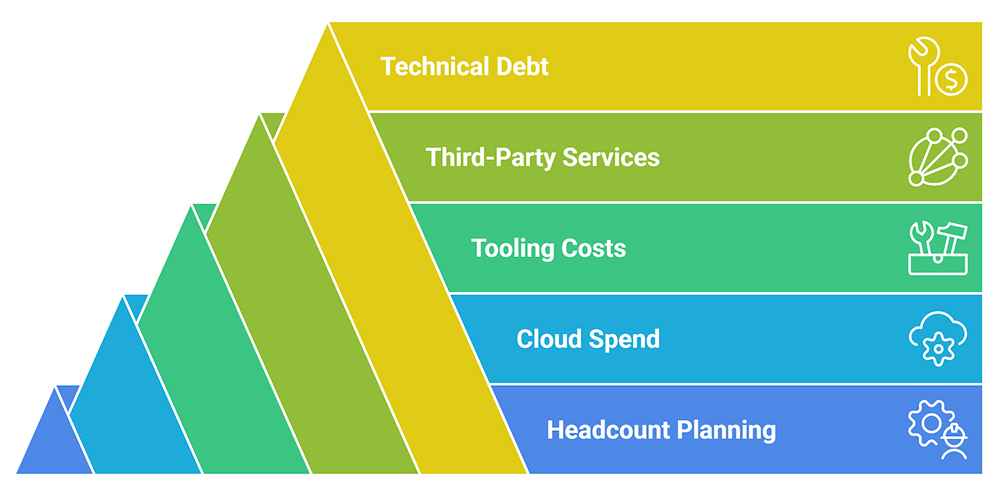
Core Areas Leaders Must Forecast

1. Headcount and capacity planning

For most engineering organizations, people remain the highest cost. That is why headcount planning needs to do more than count open roles. Leaders have to forecast hiring based on the roadmap’s needs, estimate the full cost of each role, and connect those hires to the actual delivery capacity.

This is where many teams oversimplify. A role on paper is not instant productivity. Hiring and onboarding take time, and skill level matters. Adding ten engineers does not immediately create ten units of output. Strong planning accounts for ramp-up time, skill mix, attrition risk, and real bottlenecks inside teams.

A useful headcount model usually asks a few practical questions:

  • Which roadmap commitments require new hiring?
  • What is the full cost of each role, including benefits and overhead?
  • How long does it take for each new hire to contribute meaningfully?
  • What happens if hiring is delayed?

These are not only finance questions. They directly affect delivery planning.

2. Cloud and infrastructure spend

Infrastructure costs are now closely tied to architecture and usage patterns. Unlike fixed on-premise models, cloud spending changes in real time. That means leaders need to forecast usage-based costs, model growth scenarios, and account for expected optimization work, rather than relying solely on past invoices.

A new feature can increase storage, compute, or data transfer. Expansion into a new market can increase traffic. AI-related workloads can quickly raise costs. Forecasting needs to reflect these possibilities, not just historical averages.

This is also an area where technical judgment matters. Good infrastructure planning is not only about predicting costs. It is also about identifying where technical improvements can reduce waste. Better workload scheduling, storage optimization, committed usage plans, and service redesign can all significantly affect the budget. Leaders who ignore the technical side usually miss the real cost.

3. Tooling and SaaS costs

Engineering teams now depend on a wide range of tools. Developer platforms, observability systems, CI tools, security products, documentation software, and AI-assisted coding tools all contribute to ongoing spend.

This category often grows quietly. One team adopts a tool to solve a local problem. Another team adds a similar platform. A renewal gets approved because canceling it feels risky. Over time, the tool stack becomes expensive and harder to manage.

Leaders should regularly review:

  • Which tools are heavily used, and which are not?
  • Whether overlapping products can be consolidated.
  • Whether pricing still matches actual usage or team size.
  • Which AI tools improve productivity, and which simply add cost?

Tool spending rarely looks serious in isolation, but it becomes a real budget problem when nobody clearly owns it.

4. Third-party services and APIs

Modern products rely heavily on external services. Payment systems, messaging platforms, search providers, identity tools, analytics services, and model APIs all introduce usage-based costs that can scale quickly.

These services are tricky because they often become more expensive as the product succeeds. That means leaders need to plan for adoption growth, renewal terms, minimum commitments, and pricing changes before those costs start hurting the budget. Knowing last month’s invoice amounts is not enough. Teams also need to understand what happens if usage doubles or a vendor changes pricing.

5. Technical debt and contingency buffers

Some of the most important budget items are the easiest to postpone. Technical debt reduction, modernization work, incident response readiness, and contingency reserves often get pushed aside because they are not tied to flashy roadmap items. The brief explicitly includes modernization, risk, incident response, and contingency reserves for growth or outages in this category.

That inclusion is important because these costs are not optional in serious engineering organizations. Systems age. Incidents happen. Reliability work cannot always wait until next quarter. If leaders budget only for ideal-case delivery, they create fragile plans that collapse the moment reality shows up.

Tracking and Controlling Costs Without Slowing Delivery

The answer to rising costs is not a heavier process everywhere. Most engineering teams already suffer when every decision requires approval. Effective engineering cost management works better when leaders create visibility, ownership, and practical guardrails.

The source brief outlines four methods that matter most: real-time spend visibility, cost allocation and ownership, outcome-based cost management, and guardrails instead of heavy controls.

Enhancing Engineering Cost Management

Build real-time visibility

By the time monthly reports arrive, the opportunity to correct course may already be gone. Leaders need dashboards that show budget versus actuals, unusual spikes, and trends across cloud, tooling, and vendors. Alerts for overages help teams react early instead of explaining surprises later.

Create cost ownership

Shared budgets often create fuzzy accountability. Allocating costs by team, product, or initiative makes spending easier to understand and easier to improve. When teams can see their own cost footprint, they make better choices without needing a layer of bureaucracy for every decision.

Tie spending to outcomes

Cost control becomes more useful when spending is linked to milestones and results. That means asking questions like these:

  • What did this initiative cost to deliver?
  • Did the spend improve speed, reliability, or customer value?
  • Are we funding the work with the greatest impact?

This is much more useful than debating raw spending in isolation

Use guardrails, not bottlenecks

Financial thresholds and lightweight reviews protect the budget without choking team autonomy. Teams should have the space to make sensible decisions within clearly defined boundaries. That kind of model supports speed because it keeps oversight proportional to risk.

Connecting Budget Decisions to Business Priorities

High-performing teams do not treat engineering budgets as isolated financial documents. They treat them as part of the strategy. That means linking funding to company goals, prioritizing work by impact and ROI, and making trade-offs when priorities change.

This mindset improves planning. Instead of asking only whether something is affordable, leaders ask more useful questions. Does this investment support a critical business objective? Is this roadmap item worth the cost compared with other options? Are we funding the systems and capabilities the business depends on most?

This is where software engineering budget planning becomes more than an accounting task. It becomes a way to turn strategy into practical resourcing decisions. When the budget reflects real priorities, teams understand why certain investments are protected and why some trade-offs are necessary.

Tools and Practices That Make Budget Planning Work

Strong planning depends on tools and routines that help leaders adjust before problems grow. Useful supports include real-time dashboards, roadmap and capacity planning tools, scenario modeling, cross-functional planning between engineering and finance, and AI-driven forecasting or anomaly detection.

Tools and Practices That Make Budget Planning Work

Still, tools alone are not enough. The operating rhythm matters just as much. Teams need regular reviews, updated forecasts, and shared discussions between engineering and finance. Scenario planning is especially valuable because it helps leaders prepare for uncertainty, whether that means delayed hiring, faster product growth, or unexpected infrastructure costs.

For those seeking outside examples, materials from Chrono and Waydev can offer insights into how engineering organizations manage visibility, planning, and cost management.

Conclusion

Engineering leaders in 2026 must not hold on to the practice of annual budgeting. Instead, the current operating context and cost structure should be looked at. Factors such as headcount, cloud consumption, tools, third-party services, and modernization work should be actively managed, not simply passively reviewed.

The good news is that cost control does not have to slow delivery. When leaders use continuous forecasting, transparent tracking, team-level accountability, and strong alignment with business outcomes, budget discipline becomes a delivery enabler instead of a blocker. That is the real shift in modern engineering planning. The budget is no longer just a financial document sitting beside execution. It is part of how execution is well managed.

FAQs

1. How often should engineering budgets be reviewed and reforecasted?

High-performing teams usually review spending monthly and reforecast quarterly. Fast-moving environments may do it more often. The key is to update assumptions before changing hiring plans, cloud usage, or roadmap shifts, as this makes the original budget unreliable.

2. What signals show that engineering spend is misaligned with outcomes?

Engineering spend is misaligned if costs are continuously increasing without a corresponding improvement in delivery velocity, if there is no clear reason for increasing cloud spend, if spending on tools and subscriptions does not lead to greater adoption, or if increasing headcount does not significantly contribute to throughput, reliability, or business impact.

3. How can leaders balance cost control with team autonomy?

The best approach is to use visibility and guardrails instead of heavy approvals. Teams should understand their own spend, work within clear thresholds, and keep enough freedom to make local decisions without creating bottlenecks.

4. What is the role of real-time data in budget planning?

Real-time data enables teams to manage their spend and budget versus actual consumption effectively, before small issues become big problems, helping them catch overspending. This data shifts budgeting to an ongoing, real-time exercise rather than a delayed reporting process.

5. How do high-performing teams connect engineering budgets to business priorities?

They finance work depending on strategic worth, projected influence, and ROI. They make adjustments to allocations based on shifting priorities, treating the engineering budget as a dynamic embodiment of business strategy rather than a static document.

Written by

Sign up to our newsletter

By subscribing, you accept our Privacy Policy.

Related posts

Token Theatre
Apr 15, 2026

Token Theatre

KTLO in Engineering: From Maintenance to Strategic Advantage

Ready to Transform
Your GenAI
Investments?

Don’t leave your GenAI adoption to chance. With Milestone, you can achieve measurable ROI and maintain a competitive edge.
Website Design & Development InCreativeWeb.com