Deployments, testing, infrastructure provisioning, and monitoring all became part of standard engineering workflows.
What is changing now is the type of work being automated. Rather than automating a fixed sequence of predefined steps, teams are starting to automate decision-making tasks that previously required human involvement. This is where AI agent workflow automation begins to appear in software delivery environments.
The discussion often centers on autonomous coding agents, but the more practical use cases are typically found in everyday engineering operations, where multiple systems, tools, and workflows must be coordinated.
Moving Beyond Traditional Automation
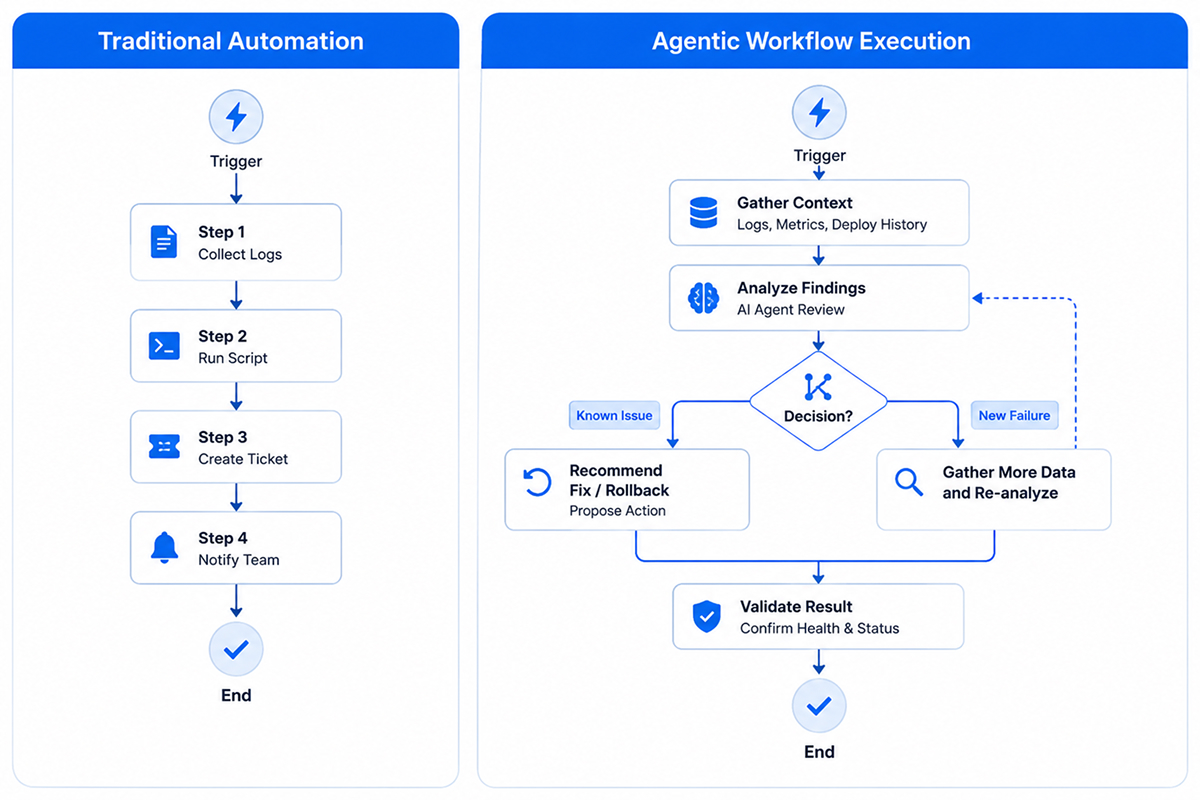
Traditional workflow automation works well when every step is known in advance. A CI pipeline compiles code, runs tests, builds artifacts, and deploys them. The workflow is predictable because the path rarely changes.
Agentic AI workflow automation introduces a different model. The workflow can adapt to context, available information, and intermediate results.
Consider a bug investigation process. A standard automation script may gather logs from a specific location and append them to a ticket. An AI agent can enhance the process by analyzing logs, identifying failure points, collecting related metrics, reviewing prior cases, and recommending potential solutions even before a developer opens a ticket.
The workflow still follows rules, but the path is no longer completely fixed.
Where AI Agents Fit Into Development Workflows
Many discussions about AI agents focus heavily on code generation. That is only one part of the picture. In software teams, a large share of engineering time is spent on activities surrounding development rather than on writing code.
Some common examples include:
- Incident triage and investigation
- Pull request analysis
- Test failure classification
- Release coordination
- Infrastructure change validation
These tasks often require collecting information from several systems before a decision can be made.
AI agent workflow automation works well in these situations because the agent can act as a coordinator among tools rather than functioning as a simple text-generation system.
For example, a release readiness workflow may include deployment dashboards, issue trackers, monitoring systems, test results, and version control repositories. The agent may receive information from all of them, apply some predefined conditions to each, and prepare a recommendation for the release engineer.
A Typical Agent Workflow
The structure of an agent workflow usually looks familiar to software engineers. An event triggers execution. The agent gathers context, evaluates possible actions, executes tasks, and verifies results before continuing.
A simplified example looks like this:

The important distinction is that the workflow can branch dynamically based on findings rather than following a rigid sequence. This flexibility is one reason interest in agentic AI for workflow automation continues to grow within engineering organizations.
Practical Software Development Use Cases
The most successful implementations tend to focus on narrow operational problems. Teams sometimes attempt to build agents that can manage entire development lifecycles. Those projects often become difficult to maintain because the scope expands faster than the available controls can keep pace with. Smaller workflows generally produce more predictable results.
One example is automated pull request reviews. An agent reviews changed files, identifies affected services, checks coding standards, evaluates test coverage, searches for related historical issues, and prepares a summary for reviewers. Human approval remains part of the process, but the initial analysis is automated.
Another example appears in platform engineering environments. An infrastructure request arrives through a ticketing system. The agent validates configuration requirements, verifies policy compliance, generates infrastructure definitions, executes provisioning workflows, and documents the resulting resources.
This is where AI agent workflow automation for software development becomes useful. The goal is not to replace engineers but to reduce repetitive operational effort.

Design Considerations
Many teams find that building the workflow is easier than operating it reliably. The agent must have access to accurate context. Poor data sources often lead to poor decisions, regardless of model quality.
A few areas deserve careful attention:
- Permission boundaries and access controls
- Workflow observability and audit trails
- Validation checkpoints before execution
- Failure recovery and rollback mechanisms
These concerns resemble traditional automation challenges, but they become more important when workflows include decision-making steps. An agent that recommends an action is different from one that executes it automatically. Engineering teams usually start with recommendation-based workflows before allowing direct execution.
Challenges That Appear Quickly
The biggest challenge is rarely model capability; instead, most problems stem from workflow design. Agents often gather incomplete context, misunderstand internal terminology, or make assumptions that seem reasonable but are actually incorrect. When these workflows interact with production systems, such issues can elevate to operational risks.
Another challenge involves maintenance. Business rules change. Internal systems evolve. APIs are replaced. Agent workflows require ongoing updates just like any other software system. Organizations adopting AI agent workflow automation software development practices often find they need monitoring, testing, versioning, and deployment processes tailored to their agent workflows.
Measuring Success
Success metrics are usually operational rather than model-centric.
Useful measurements include:
- Mean time to incident resolution
- Pull request review preparation time
- Deployment coordination effort
- Ticket processing duration
- Percentage of automated workflow completion
These metrics provide a clearer view of business impact than model benchmarks. Many teams use platforms like Milestone to track AI usage and proficiency, measure workflow impact, and connect productivity improvements to business outcomes. Most engineering leaders care less about model sophistication and more about whether a workflow saves meaningful engineering time without introducing additional risk.
Conclusion
AI agent workflow automation is gradually becoming another layer within software delivery systems rather than a separate category of tooling.
The most practical implementations focus on workflows that require information gathering, coordination, and limited decision-making. Well-defined operational processes tend to benefit first. Broader autonomous systems remain possible, but they are usually much harder to manage than they appear during early experimentation.
For many teams, the value comes from reducing friction in existing workflows rather than reinventing how software is built.