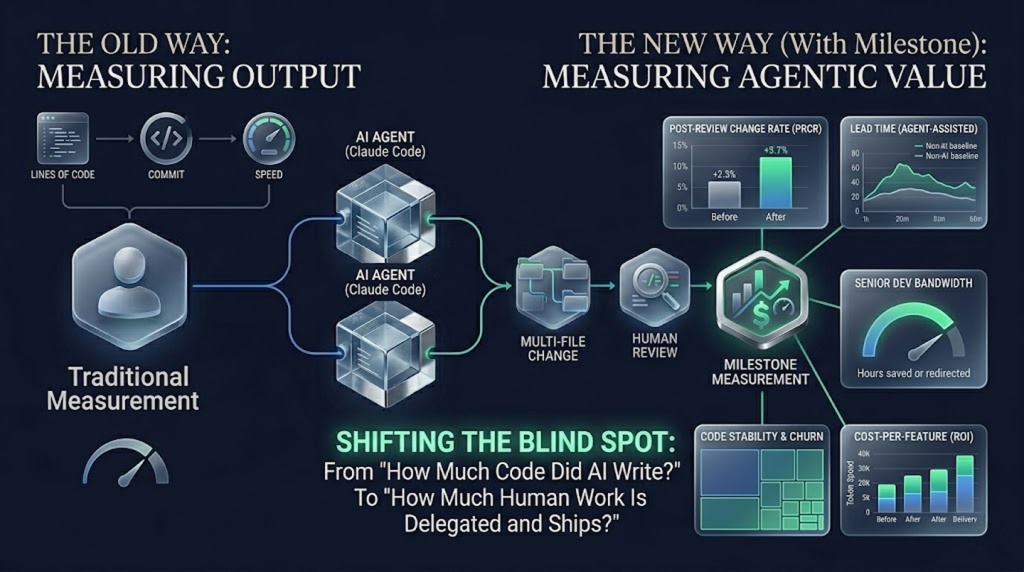
The way engineers write code has changed faster than most measurement systems have kept up with. With Claude code, a developer doesn’t sketch out a function and refine it line by line. They describe what needs to happen, across multiple files, multiple services, sometimes an entire feature, and an agent goes and does it. The developer’s job shifts from writing to directing, reviewing, and deciding what happens next.
That shift creates a new kind of blind spot. It’s no longer useful to ask “how much code did AI write?” The real questions are: How much of an engineer’s actual workload is now being delegated to an agent, what happens to that work once a human reviews it, and is the team still in control of what’s shipping?
Most engineering organizations don’t have a clear way to measure Claude Code productivity today. Milestone exists to close that gap.
Why Measuring Agentic Development Is Different
Traditional AI developer productivity metrics were built around a model in which a developer writes most of the code, and AI fills in the gaps. That model is largely gone. One of the defining Claude Code features is its ability to plan a change, implement it across a dozen files, write tests, and iterate on its own output before a human ever opens the diff.
This means the old proxy metrics, such as how often a suggestion is accepted, no longer carry much weight. Engineers aren’t accepting or rejecting individual lines; they’re reviewing entire changes, sometimes entire features, and deciding whether to merge, send them back for another pass, or rewrite. The unit of work has gotten bigger, and so have the stakes of getting it wrong.
For engineering leaders, this raises a governance question as much as a productivity one. If an agent is writing a growing share of your codebase, you need visibility into where that’s happening, how much of it survives review unchanged, and whether your team’s understanding of the system is keeping pace with the code being produced. Without that visibility, you’re not managing AI adoption, you’re just hoping it’s going well.
What Milestone Measures for Claude Code Teams
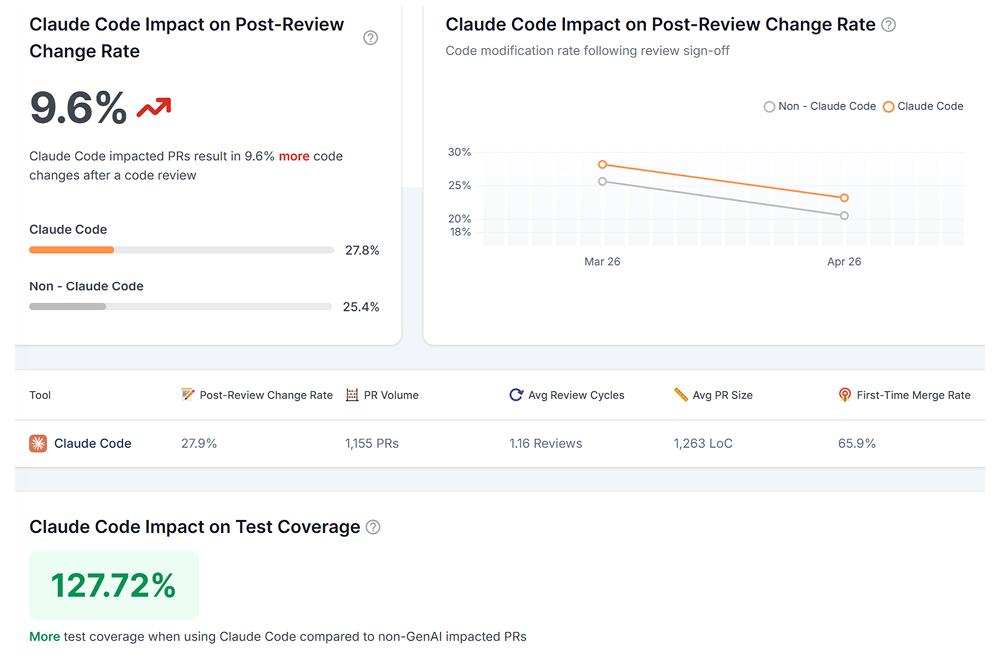
Milestone’s view of Claude code productivity rests on three dimensions: velocity, quality, and the cognitive load placed on your team. Claude Code is one of the clearest places to apply that lens, because the gap between output and value shows up so plainly.
Output vs. value is the core distinction. Output is easy to see – commits, PRs opened, lines changed, features touched. Value is harder: did that work make it through review intact, did it ship, hold up afterward, and actually move the team closer to its goals?
An agent can generate an enormous amount of output in an afternoon. Whether that output is valuable depends entirely on what happens next, and that’s the part most teams have no visibility into.
Milestone connects Claude Code activity to your Git history, pull request workflows, and delivery timelines, answering that question directly. For teams running agentic workflows, this means tracking how much of a PR generated through Claude Code gets rewritten after review, how long agent-assisted changes take to actually reach production compared to your historical baseline, and where the review burden is landing on your senior engineers.
If your most experienced people are spending their days re-architecting agent output rather than reviewing it, that’s a signal worth seeing early.
This is especially relevant for AI-native and platform teams who’ve moved fast on adoption and now need to answer harder questions: which teams are getting real leverage from agentic workflows, which are generating churn, and where delegation is working well enough to expand, versus where it needs guardrails.
Milestone gives you that picture across teams, not just at the individual level.
The Metrics That Matter for ROI
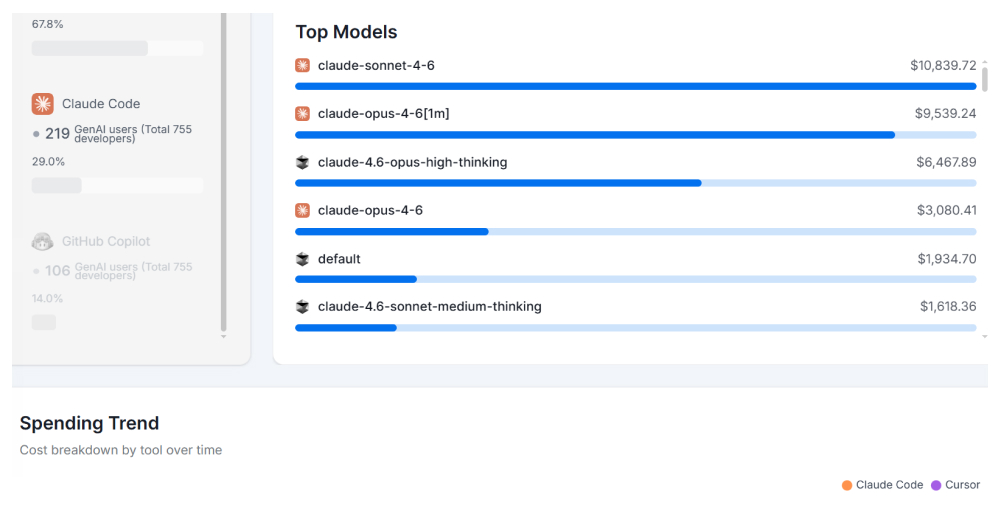 If you’re trying to justify or scrutinize the investment in Claude code, here’s what to look at:
- Post-Review Change Rate (PRCR): The percentage of Claude Code-generated work that gets meaningfully rewritten after a human reviews it. This is the clearest single signal of whether agentic output is holding up or creating rework.
- Lead Time for Changes: The time from an agent-initiated change to a successful merge, benchmarked against your non-AI baseline. This tells you whether delegation is actually compressing your delivery cycle or just moving the bottleneck.
- Senior Dev Bandwidth: Whether your most experienced engineers are reviewing and guiding agentic work efficiently, or absorbing the cost of fixing it. This is often where the real economics of agentic development show up.
- Code Stability: Tracking rework and churn on agent-generated code over time, so quality issues get flagged before they compound.
- Cost-per-Feature: Connecting token spend and engineering time to what actually ships, so the investment in Claude Code can be measured against real delivery.
Closing the Loop on Agentic Development
Claude Code and tools like it are only going to get more capable and more autonomous. That’s the point. But autonomy without visibility is just risk wearing a faster hat. The execution layer, such as the editor, the agent, and the diff, was never going to be where value gets measured. It doesn’t know your Git history, your delivery timelines, or what happened to its own output three weeks after it was merged.
That connective layer is what Milestone provides. Not a record of how much an agent did, but a record of what that work became, whether it shipped, whether it held, whether it freed up your best people or quietly added to their load.
Many engineering organizations are now running Claude code alongside tools like Cursor or GitHub Copilot, often for different use cases or different teams. Milestone gives you a single dashboard across all of them, so you can see which tools and workflows are actually generating value.
If you want to know whether your investment in Claude Code is producing output or producing value, book a demo with Milestone.
FAQs
1. How does Milestone measure the productivity impact of Claude Code?
Milestone connects Claude code activity to your Git, PR, and delivery data, then compares agent-assisted work against your historical baselines. It tracks how quickly changes move from initiation to production, how much gets rewritten after review, and where time is spent, giving you a clear view of output versus the value actually delivered.
2. What metrics does Milestone track for teams using Claude Code agents?
Key metrics include Post-Review Change Rate (PRCR), Lead Time for Changes, code stability and churn, senior developer review time, and cost per feature. Together, these show whether agent-generated work is reaching production cleanly or creating rework, and whether the investment in Claude Code is translating into real AI developer productivity gains.
3. Can Milestone show how much of our codebase was written with Claude Code?
Yes. Milestone tracks the share of commits, PRs, and code changes attributable to Claude Code across teams and projects. More importantly, it shows what happens to that work afterward, how much survives review unchanged versus how much requires significant rework before it ships.
4. How is measuring Claude Code different from measuring Copilot or Cursor?
Claude Code operates more autonomously, often planning and executing multi-file changes with less line-by-line human authorship. This shifts the measurement question from “Is the developer faster?” to “How much work is being delegated, and is the team still in control of it?” Milestone’s governance and value metrics are built for that distinction.
5. Can Milestone track Claude Code alongside other AI coding tools we use?
Yes. Many teams run Claude code, Cursor, and GitHub Copilot simultaneously, often across different projects. Milestone gives you a single dashboard to compare adoption, Claude Code productivity, and ROI across all of them, so budget and workflow decisions are based on data, not on which tool is trending.