In this digital age, application performance is crucial for user engagement. Users want applications to be quick and easy to use. Even slight delays can negatively impact consumer satisfaction and significantly affect business. Therefore, developers must have complete control over the application.
This is where performance engineering comes in-it ensures applications are designed to deliver speed, reliability, and efficiency from the ground up. This guide explores the essential components and capabilities of performance engineering.
Understanding Performance Engineering
Performance engineering is a practice that aims to integrate performance into the software development life-cycle proactively and in a systemized manner. Instead of fixing things reactively, it is about designing systems to meet performance objectives.
This discipline also optimizes resource utilization (CPU, memory, network, and storage) to ensure efficiency, responsiveness, reliability, and scalability.
Key Benefits of Performance Engineering
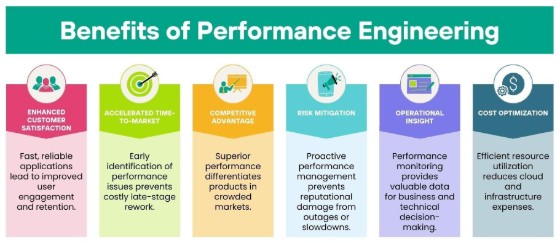
Effectively implementing performance engineering principles provides numerous benefits, including:
- Predictable performance: Systems provide consistent responses regardless of dynamic load conditions.
- Scalability: Applications scale with the growing user base, data, and transaction throughput.
- Resource efficiency: Efficiently utilizing computing resources decreases operations costs while meeting performance goals.
- Resilience: Systems degrade gracefully in critical conditions instead of collapsing drastically.
- Focus on user experience: Efficient interfaces and operations meet user expectations.
Critical Components of Performance Engineering
Below are the essential components of performance engineering and how they contribute to achieving optimal system performance.
1. Performance Requirements Analysis
- Identify key performance indicators (KPIs) that align with business goals.
- Define specific targets for response time, throughput, latency, and scalability.
- Translate user expectations into measurable performance requirements.
2. System Architecture and Design Optimization
- Design scalable and resilient architectures.
- Consider load balancing, caching, and microservices.
- Monitor cloud and containerization impact on performance.
3. Performance Testing & Benchmarking
- Utilize appropriate performance engineering testing according to the requirement (i.e., load, stress, soak, spike, and scalability testing).
- Choose the right tools (JMeter, Gatling, k6).
- Define realistic test scenarios.
4. Monitoring and Observability
- Use real-time monitoring tools for observability (Prometheus, Grafana, Datadog).
- Use logs, traces, and metrics for proactive performance tuning.
5. Performance Bottleneck Analysis
- Identify and analyze slow queries, memory leaks, and CPU bottlenecks.
- Profiling and root cause analysis.
- Consider your development environment and tools,e.g., APM (application performance monitoring).
6. Continuous Performance Optimization
- Integrate performance testing into CI/CD pipelines.
- Automate performance monitoring and tuning.
7. Code Level Optimization
- Database optimizations (indexing, query optimization).
- Caching strategies and implementation.
- Content delivery and frontend performance techniques.
8. Performance in Cloud and Distributed Environments
- Auto-scaling strategies and implementation.
- Container and orchestration performance optimization.
- Edge computing for performance enhancement.
- Multi-region deployment strategies.
9. Performance Culture and Organizational Aspects
- Build a performance-focused engineering culture.
- Integrate performance engineering into DevOps practices.
- Consider performance budgets and their management.
Performance Engineering Frameworks
Performance engineering frameworks provide structured methodologies to integrate performance considerations into development. They define best practices, set benchmarks, and guide testing, monitoring, and optimization to ensure systems meet performance goals.
These are some key frameworks:
- Performance engineering and architecture (PEAR) : Integrates performance into system architecture and development with templates for requirements and workload modeling.
- Response-based performance engineering (RPE) : Prioritizes end-user response time, breaking it into components to identify bottlenecks and optimize user experience.
- Microsoft performance testing methodology (MPTM) : Guides test planning, scenario creation, and data analysis, emphasizing performance visualization.
- Google’s RAIL model : A user-focused framework optimizing response, animation, idle, and load (RAIL) for better interaction performance.
- Capability maturity model for performance engineering (CMMPE) : Assesses performance maturity levels and provides roadmaps for improvement with industry benchmarking.
Performance Engineering Challenges and How to Overcome Them
1. Handling Dynamic Workloads
Modern applications encounter increasingly unpredictable traffic patterns and workloads, posing significant performance engineering challenges.
Solutions:
- Adopt elastic infrastructure.
- Employ traffic shaping techniques (queuing systems, rate limiting, and prioritization mechanisms).
- Conduct stress testing beyond expected peaks.
2. Addressing Third-Party Dependencies and API Performance
Modern applications rely heavily on external services, creating performance challenges outside direct control.
Solutions:
- Monitor all third-party service performance as rigorously as your systems to identify degradation quickly.
- Reduce dependency on real-time external calls by implementing intelligent caching strategies.
- Simulate dependency failures in testing.
3. Dealing with Unpredictable User Behavior
Users interact with systems in ways that often defy predictions, creating performance engineering complexities:
Solutions:
- Analyze user behavior across segments.
- Conduct A/B performance testing.
- Create adaptive performance throttling.
Final Thoughts
Performance engineering has transitioned from a reactive technical activity to a strategic business discipline, leading to digital success. By establishing organized applications, organizations can offer great digital experiences that satisfy users while accomplishing business goals. As technology evolves rapidly, those who master this discipline will maintain a crucial edge in the increasingly impatient digital world.