Why Are Our Software Releases So Painful, and How Do We Fix the Process?
Written by

Status
answered
Written by
Status
answered
A painful release rarely starts on release day. It usually starts earlier, when small gaps are ignored because the team is still moving forward.
A branch stays open too long. Test failures become routine. Deployment steps live in one engineer’s head. By the time the release begins, the team is not only shipping software but also trying to recover from a weak software release process.
Teams often blame release pain on tooling. The deployment pipeline is slow, the test suite is unreliable, and the staging environment is out of date. Those issues matter, but they are usually symptoms of a process that is not sufficiently clear to withstand normal engineering pressure.
This is where release management becomes more than a checklist. A release needs ownership, decision points, rollback paths, communication rules, and sufficient visibility to confirm the software is actually ready. Without that, even a good team ends up relying on memory, Slack messages, and last-minute coordination.
Teams that want to understand where release work gets stuck often need to map the path from code change to production. A practical starting point is to use stream mapping tools for software delivery, because release pain is easier to fix when handoffs and delays are visible.
Most release failures recur because the same weak points remain unaddressed. The team may improve one deployment, but the next release runs into the same friction again.
A common problem is late integration. Developers work in separate branches for too long, then merge near the release window. The code may compile, but behavioral conflicts appear late, and tests fail for reasons no one noticed earlier.
Another failure point is environmental drift. Staging does not match production. Test data is incomplete. Feature flags are configured differently. The deployment looks safe in one environment, but behaves differently after release. This erodes trust in the process, so teams add more manual checks, which do not always reduce risk.
A few breakdowns show up often:
A fragile continuous delivery setup can look mature from a distance. There is a CI system, tests, and maybe automated deployment, but release health remains hard to prove when work is scattered across tools. A tool like Milestone can help teams measure GenAI adoption, ROI, workflow visibility, and engineering performance alongside the release signals they already track.
A healthy release process does not mean every deployment is risk-free. Software always carries some risk. The goal is to make the risk smaller, earlier, and easier to handle.
The process starts before the code is merged. Changes should be small enough to review thoroughly. Tests should run early, not just near the release window. Riskier work should use feature flags or staged rollouts to separate deployment from full customer exposure.
The deployment pipeline should also be boring. Build, test, package, deploy, verify, and roll back should follow established paths. Engineers should not need to remember special steps unless the release is genuinely unusual.
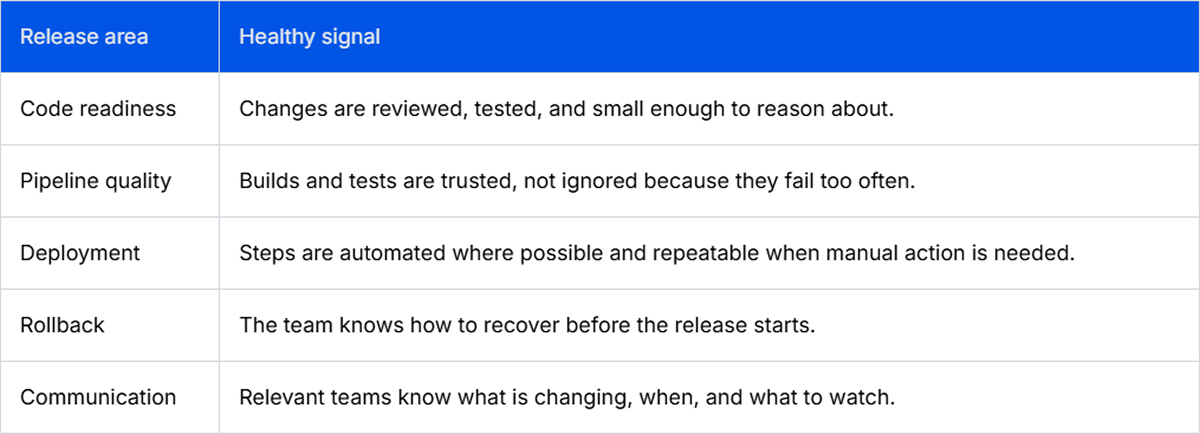
This does not require a heavy process. A team might define that every release needs a named release owner, a passing deployment pipeline, a rollback note, and a short change summary. That is not much paperwork, but it gives the team a shared baseline.
Teams can also improve release management by integrating release work into the rest of the SDLC. Planning, coding, testing, review, deployment, and incident response should not be treated as disconnected activities. When those stages are fragmented across tools, release problems become harder to detect. Reviewing SDLC tools that streamline workflows can help teams identify where handoffs are slowing them down.
The best fixes are usually practical. Reduce batch size, make tests reliable, automate repeatable tasks, keep rollbacks simple, and document the release decision rules. A painful deployment should not be treated as a one-off if the same problems keep recurring.
A painful release usually indicates that the process has too many hidden gaps. Better tooling can help, but only after the team understands where the release path breaks. A healthier software release process makes work visible earlier, keeps the deployment pipeline predictable, and gives people fewer opportunities to improvise under pressure.