When Should I Hire More Engineers, vs Invest More in AI Tools?
Written by

Status
answered
Written by
Status
answered
Engineering leaders usually sense the hiring question before it appears clearly in a report. A roadmap expands. Support work grows. Senior engineers complain that reviews, meetings, and interruptions are eating up their week.
The tempting answer is simple: hire more engineers. Sometimes that is right. Other times, the team does not lack people. It lacks clear workflows, better tooling, and a more honest view of capacity.
Investing in AI tools makes sense when the problem is repetitive work, not a lack of ownership. If engineers spend hours writing basic tests, searching through old code paths, or preparing small refactors, AI coding tools can reduce that drag.
A new hire helps when a team needs real accountability. Platform reliability, security review, release engineering, or a new product surface usually needs someone who owns the work.
Developer productivity is often blocked by slow CI, flaky tests, overloaded reviews, or unclear ownership. Adding another engineer to that system may only add more coordination. Use AI tools when the work is understood but slow. Hire when the work requires judgment, domain knowledge, and long-term ownership.
The cost of engineering hiring is not just salary. It includes recruiting time, interview load, onboarding, manager attention, ramp-up delay, and additional communication paths. Good engineers are expensive, but the hidden cost is often the time taken from the existing team.
AI tools have their own costs. Licenses are only the visible part. Teams also need guidance on usage, security and code review expectations, prompt habits, and a way to measure whether the tools are helping or just creating more code to inspect.
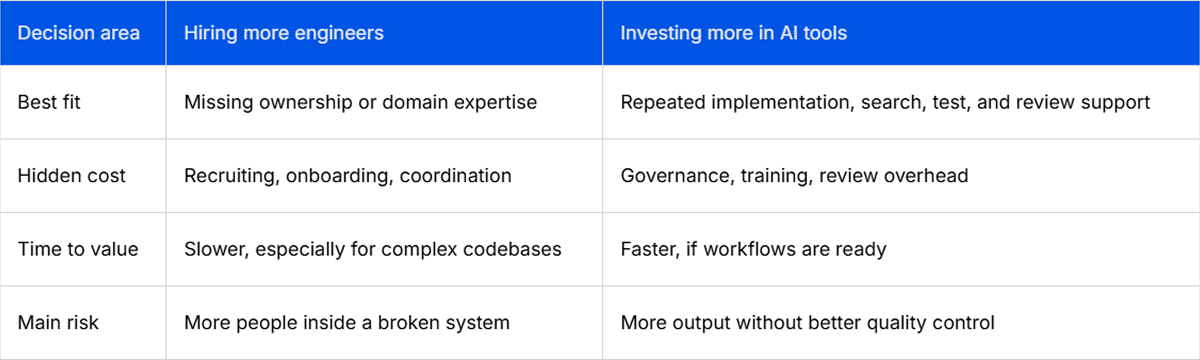
The mistake is treating the two options as interchangeable. They are not. Hiring increases human capacity. AI tools increase leverage on existing capacity, but only when the team knows where to apply it.
For that reason, leaders should base the decision on engineering capacity planning rather than headcount pressure alone. Look at where engineering time is going today. Separate feature work from maintenance, incidents, reviews, meetings, and internal support. The answer often becomes less emotional after that.
The decision should not be made once during annual planning and then forgotten. Tooling changes. Team maturity changes. The roadmap changes. A lightweight framework is more useful than a big model that nobody updates.
Start with a few practical signals.
These signals should lead to different actions. A skill gap usually points toward hiring. Workflow drag may point to AI tools. When AI use is already growing, Milestone can help measure GenAI adoption, ROI, workflow visibility, and engineering performance before additional budget is allocated.
The useful question is not “Can AI replace a hire?” That framing usually leads to poor planning. A better question is “What work needs human ownership, and what work is slowing down the humans we already have?”
Some teams also need a budget checkpoint. If AI tools are becoming a normal part of engineering work, leaders should treat them as an operating investment, not a side experiment. A clear view of AI tool budgets for engineering leaders helps avoid random licensing, uneven adoption, and unclear ROI.
After that, compare options against the next two quarters, not a vague future. If the team needs a service owner by next month, hire or reassign. If the team is losing time in every sprint to code search, boilerplate, tests, and review prep, invest in better AI-assisted workflows. If both apply, do not pretend one decision will solve both problems.
Engineering hiring is still necessary. AI tools are also becoming part of the normal engineering infrastructure. The hard part is knowing which problem you are solving.
Hire when ownership, judgment, or expertise is the bottleneck. Invest in tools when capable engineers are bogged down by repetitive work. Then review the decision again before the next planning cycle.