Multi-Agent System Design: Architecture Decisions for Development Teams
8 min read• Jul 01, 2026
Written by

Milestone Team

AI agents are moving from small internal experiments into real production workflows, including support, research, code review, data analysis, and compliance checks. A single agent can work well for a narrow task, but production workflows often require planning, retrieval, tool execution, validation, review, and escalation.
This is where multi-agent system design helps. It lets teams split complex AI workflows into smaller parts, where each agent has a clear job. The goal is not to add complexity, but to build AI systems that are more reliable, observable, and maintainable.
A multi-agent system is an architecture in which multiple AI agents work together to complete a task. Each agent has a role, a set of tools, and a boundary defining what it should or should not decide.
For example, a customer support workflow might include:
This is different from giving one large agent every instruction and every tool. In that model, the agent has to decide everything by itself. It may work in a demo, but it often becomes messy in production.
A good multi-agent setup feels more like a software system composed of services. Each part has a responsibility. Each handoff has a purpose. Each output has a contract.
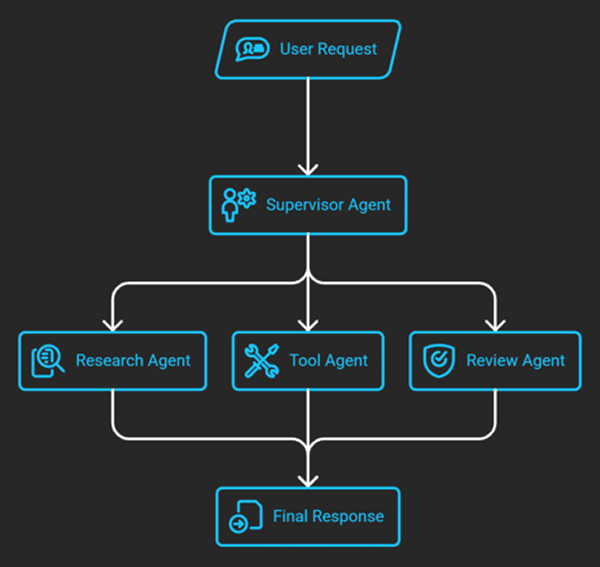
Simple multi-agent workflow diagram
Not every AI workflow needs multiple agents. In fact, many should start with one agent. A single-agent approach is easier to build, test, and monitor. If the task is narrow and the failure cost is low, keep it simple.
A multi-agent architecture becomes more useful when the workflow has clear separations. For example, the system may need to use several tools, apply different reasoning steps, or run parts of the task in parallel. It may also need a stronger review before an answer reaches the user.
Teams should consider multi-agent systems when:
There is a practical way to think about this. If your agent prompt starts to look like a long operations manual, you may be hiding several agents in a single prompt.
Before choosing a framework or writing orchestration code, teams need to answer a few design questions.
1. How many agents are really needed?
More agents do not automatically mean better results. Each agent adds latency, cost, failure points, and more logs to inspect. Start with the smallest useful split.
2. Should agents run sequentially or in parallel?
Sequential workflows are easier to reason about. Parallel workflows can be faster, but they require stronger merging and conflict-resolution logic.
3. Who makes the final decision?
Some systems use a supervisor agent. Others use deterministic application logic. In regulated or sensitive environments, the final decision may need a human reviewer.
4. What should happen when agents disagree?
This is not a small detail. If one agent approves an answer and another rejects it, the system needs a rule in place. Without one, the architecture becomes unpredictable.
A useful early design table looks like this:
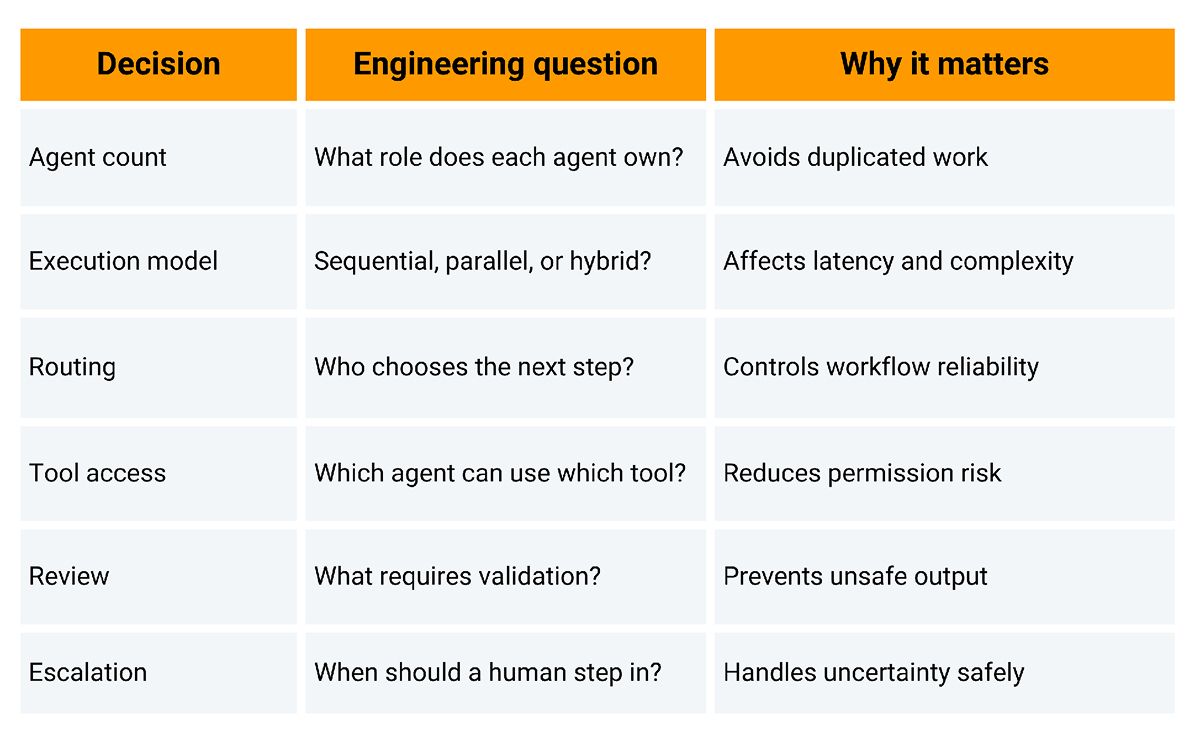
These decisions shape the whole system. Changing them later is possible, but it is rarely painless.
There are several common patterns in multi-agent system design. In production, teams often combine multiple patterns depending on workflow complexity, control needs, and tool usage.
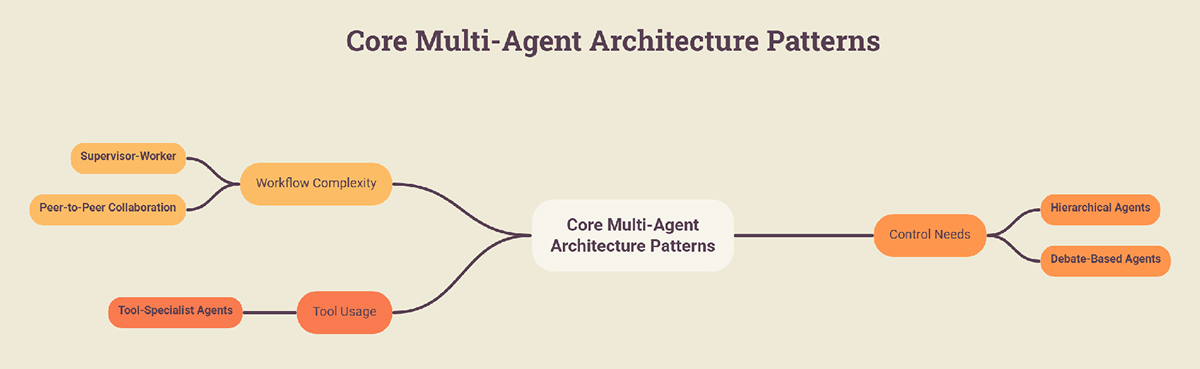
A supervisor agent receives the task and delegates work to specialist agents, such as a research agent, a coding agent, a tool agent, or a review agent. This pattern works well when one component needs to manage routing and assemble the final output, but it comes with a trade-off in centralization. If the supervisor makes poor decisions, the entire workflow can suffer.
In this pattern, agents communicate directly with each other. One agent may ask another for help, compare outputs, or continue from another agent’s result. It gives teams flexibility, but it is harder to control because open-ended agent conversation can waste tokens and create unclear ownership.
A hierarchy works like a management tree. A top-level agent breaks work into larger tasks, while lower-level agents handle smaller parts. This can fit complex workflows such as long-form research, planning, or multi-step analysis, but more layers also mean more handoffs, more latency, and more chances for context to drift.
Multiple agents produce different views, then a judge or evaluator selects the best answer. This can help when the quality of reasoning matters, especially in review, risk analysis, and decision support. However, debate-based workflows cost more and require clear evaluation rules; otherwise, the judge becomes another weak point.
Each agent owns a tool or tool group. One handles database queries, another handles document retrieval, and another may handle web research or code execution. This pattern is clean because permissions are easier to manage, and it works best when tool boundaries are stable and well-defined.
The fastest way to create confusion in multi-agent systems is to assign overlapping responsibilities to agents. If two agents can both search, summarize, validate, and decide, neither has clear ownership. Each agent should have a concise role definition. It should explain what the agent owns, which tools it can use, what input it expects, what output it must return, and where its authority ends.
Tool access should also be limited. A review agent may not need write access to the database. A research agent may not need permission to send emails. A routing agent may not need access to sensitive records.
This is a basic engineering discipline, but it matters even more with AI agents. Clear boundaries reduce unexpected behavior and make logs easier to inspect when something goes wrong.
Agents should not coordinate through vague conversation alone. That may look impressive in a demo, but production systems need structure.
Common coordination methods include structured messages, shared state, task queues, workflow engines, event-driven orchestration, and handoff protocols. Some frameworks support handoffs in which control moves from one agent to another based on the workflow state. Others give developers lower-level control over messages and events.
A simple handoff contract may look like this:
{
  "task_id": "case-1042",
  "from_agent": "research_agent",
  "to_agent": "review_agent",
  "status": "ready_for_review",
  "summary": "Found three matching policy documents.",
  "evidence_refs": ["doc-18", "doc-27"],
  "risk_level": "medium"
}
This structure is not exciting, but it is dependable. The receiving agent knows what it is getting. The orchestrator can log it. A developer can inspect it later.
That is the difference between a system that can be debugged and one that only works when nobody touches it.
State management is one of the hardest parts of multi-agent systems. Each agent needs enough context to complete its task, but too much context can slow the system, making it more expensive and harder to control. Teams usually need to manage session state, shared memory, long-term memory, retrieved documents, and task history.
The main risk is inconsistency. One agent may use fresh data while another works from stale memory. A review agent may approve an answer without seeing the evidence behind it. To avoid this, teams should treat context as part of the architecture. Store important state in a reliable layer, pass references instead of large raw context where possible, and add timestamps, source identifiers, and clear memory update rules.
Multi-agent architectures can improve quality, but they are not free. Every extra agent call adds cost. Every handoff adds latency. Every validation step adds more complexity to the workflow.
Parallel execution can reduce wait time, but only when tasks are truly independent. Running several agents at once is wasteful if most of them depend on the same first result. Caching can help with repeated retrieval, classification, or validation steps. Smaller models may also work well for routing, formatting, or simple checks.
Teams need to track the number of tokens used, the frequency of tool calls, the frequency of retries, the failure rate, the frequency of human intervention, and the frequency of final answer corrections. These metrics indicate whether the architecture is doing something useful or just busywork.
Agent conflicts happen when responsibilities overlap, instructions disagree, or outputs are not validated. One agent may say the answer is ready, while another marks it as unsafe. A third may rewrite the response and remove important evidence.
The fix is to design authority rules. For example, a compliance review agent may have veto power, while a supervisor may route tasks but not override policy checks. Useful safeguards include retry limits, fallback behavior, schema validation, confidence thresholds, conflict-resolution rules, and human escalation paths. Human review should not be treated as a failure. In many systems, it is the safest option when agents are uncertain.
Several frameworks can help teams build multi-agent workflows. The right choice depends on control requirements, observability needs, workflow complexity, and production constraints.
LangGraph is helpful for graph-based workflows, stateful orchestration, and managed handoffs. AutoGen supports event-driven multi-agent applications and collaborative agent patterns. CrewAI is about agents, crews, flows, guardrails, memory, and observability. Semantic Kernel is a fantastic fit for organizations that live in the Microsoft ecosystem and want to tie AI behavior back to application code.
The framework you choose should be based on architectural needs, not popularity. Simple workflows may require only a bespoke orchestrator, while more sophisticated workflows might require a specific framework.
It is not only the addition of more agents, but also deliberate design decisions that give rise to an effective multi-agent architecture. The well-designed designs make the roles, boundaries, communication rules, state management, validation, and escalation routes apparent.
Teams should start small, add agents only when there’s a clear rationale, and measure system behavior in production. And that’s how you turn AI prototypes into systems teams can trust.
Use a multi-agent system if your workflow has: several specialized steps, different tool demands, parallel jobs, validation needs, or human review points. If one agent can perform the work clearly and safely, then a single-agent strategy is typically superior.
Use structured coordination. This could include message schemas, task queues, shared state, workflow orchestration, event-driven routing, or handoff protocols. Don’t rely too much on open-ended agent talk.
The major trade-offs involve cost, delay, and complexity. More agents generally means more model calls, more tool calls, and more logs to monitor. Overhead can be reduced using parallel execution, caching, smaller models, and unambiguous routing.
Define authority rules, validation layers, retry limits, fallback behavior, and escalation paths. Each agent should have a clear role and defined decision boundaries. High-risk decisions should include deterministic checks or human review.
Common options include LangGraph, AutoGen, CrewAI, Semantic Kernel, and custom orchestration frameworks. The best choice depends on workflow complexity, required control, observability needs, team stack, and production constraints.
Sign up to our newsletter
By subscribing, you accept our Privacy Policy.